Unscented Moisturiser Market Overview:
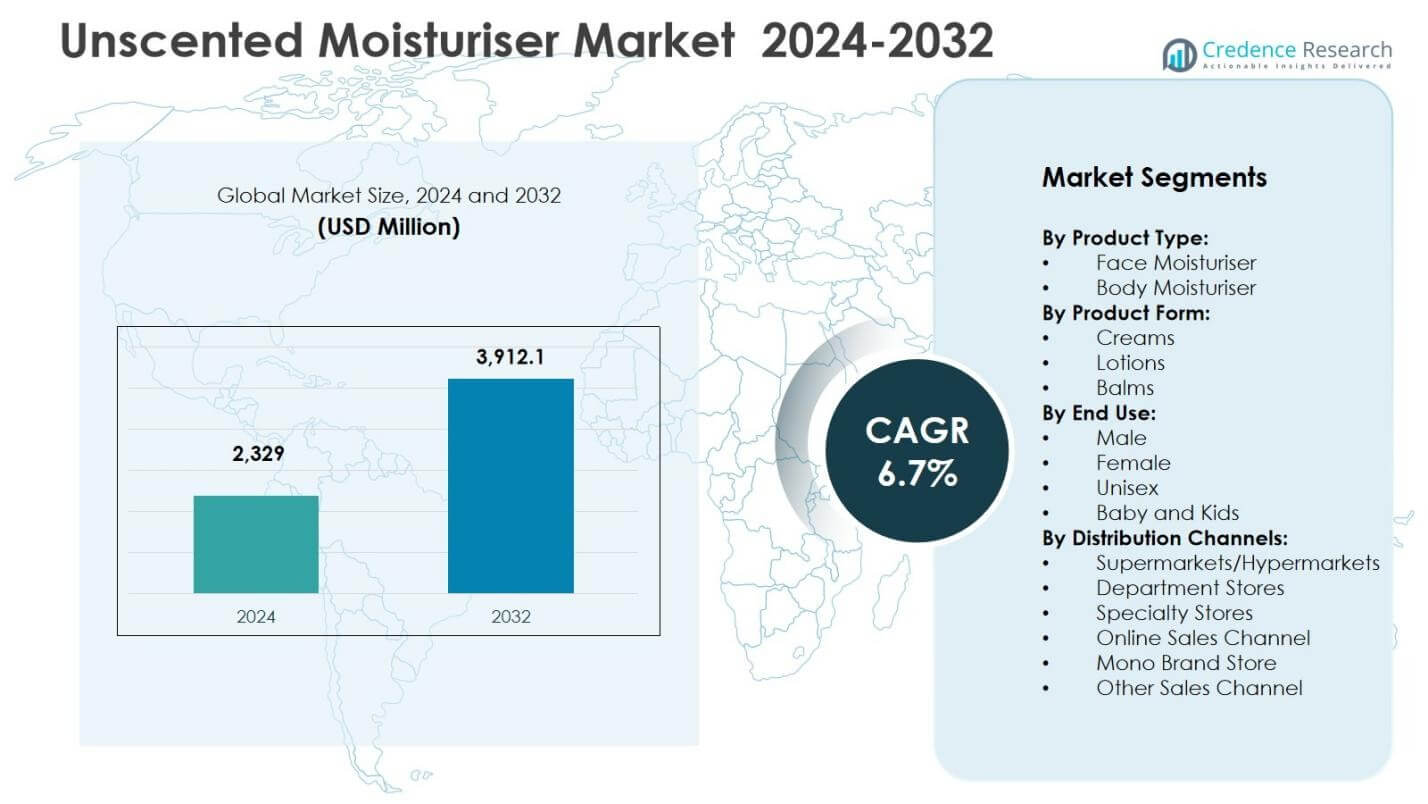
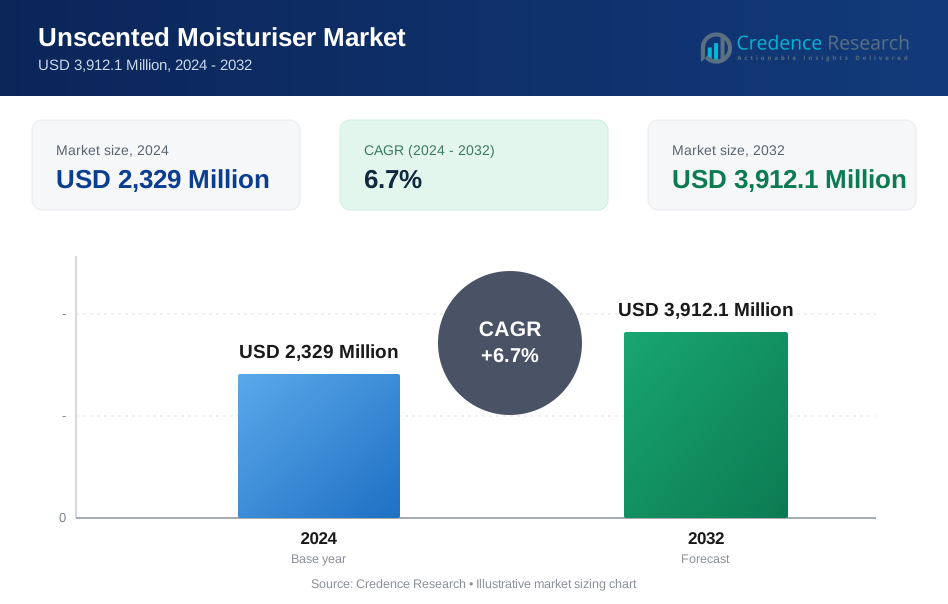
Unscented Moisturiser Market size was valued USD 2,329 Million in 2024 and is anticipated to reach USD 3,912.1 Million by 2032, at a CAGR of 6.7% during the forecast period.
| REPORT ATTRIBUTE | DETAILS |
|---|---|
| Historical Period | 2020-2023 |
| Base Year | 2024 |
| Forecast Period | 2025-2032 |
| Unscented Moisturiser Market Size 2024 | USD 2,329 million |
| Unscented Moisturiser Market, CAGR | 6.7% |
| Unscented Moisturiser Market Size 2032 | USD 3,912.1 million |
Unscented Moisturiser Market Insights
- Strong growth is driven by rising adoption of fragrance-free skincare for sensitive and allergy-prone skin, with the Face Moisturiser segment leading the market in 2024 with a 58.6% share due to increasing demand for dermatologist-recommended hydration products.
- Key trends include premium barrier-repair formulations and clean-label innovation, while Creams accounted for a 54.9% share in 2024 as consumers preferred richer, clinically aligned moisturising textures for dry and reactive skin conditions.
- Market players expand portfolios across face, body, baby, and unisex categories and strengthen pharmacy, online, and specialty retail presence, supported by transparent ingredient positioning and clinically validated fragrance-free product development strategies.
- Restraints include price sensitivity and strong presence of scented alternatives, while regionally North America led with a 32.6% share in 2024, followed by Europe at 28.4% and Asia Pacific at 24.1%, reflecting diverse demand patterns across mature and emerging skincare markets.
Market Segmentation Analysis:
By Product Type:
In the Unscented Moisturiser Market, the Face Moisturiser segment dominated the product type category in 2024 with a 58.6% share, driven by strong consumer demand for fragrance-free facial hydration solutions suitable for sensitive and acne-prone skin. Dermatologist-recommended formulations, barrier-repair actives, and daily skincare adoption across urban consumers further strengthen this leadership. The Body Moisturiser segment accounted for the remaining 41.4% share, supported by rising concerns over dryness, eczema, and allergy-safe grooming routines, particularly among consumers seeking gentle, non-irritating body care products with clean-label positioning.
- For instance, CeraVe’s fragrance-free PM Facial Moisturizing Lotion uses three essential ceramides, niacinamide, and hyaluronic acid to restore the skin barrier overnight while remaining non-comedogenic and suitable for sensitive skin.
By Product Form:
Creams represented the leading product form in the Unscented Moisturiser Market in 2024, capturing a 54.9% share due to their richer emollient profile, superior barrier-repair performance, and strong suitability for dry and sensitive skin conditions. Growth is supported by dermatology-backed formulations and increasing winter-season usage across mature markets. Lotions held a 33.7% share, appealing to consumers seeking lightweight daily hydration and fast absorption, especially in warmer climates. Balms accounted for 11.4% share, gaining traction in niche segments such as targeted repair, cracked-skin care, and ultra-sensitive or medical-support skincare routines.
- For instance, Cetaphil Moisturizing Cream provides 48-hour hydration for dry, sensitive skin through its blend of niacinamide, panthenol, and glycerin, while enriched with sweet almond oil and vitamin E to restore the moisture barrier without greasiness.
By End Use:
The Female segment led the Unscented Moisturiser Market in 2024 with a 39.8% share, driven by higher skincare adoption, strong awareness of sensitive-skin safety, and growing preference for fragrance-free, dermatologist-tested moisturising routines. The Unisex segment accounted for 36.5% share, supported by the increasing popularity of gender-neutral skincare and universal hypoallergenic positioning. The Male segment held a 14.7% share, reflecting rising grooming consciousness and minimal-scent product acceptance. The Baby and Kids segment represented 9.0% share, with growth driven by paediatric-safe, non-irritant formulations designed for delicate and clinically sensitive skin.
Key Growth Drivers
Rising Prevalence of Sensitive and Allergy-Prone Skin
The Unscented Moisturiser Market grows significantly as consumers increasingly experience sensitive, irritation-prone, or allergy-affected skin due to urban pollution, harsh climatic exposure, and chemical-heavy personal care routines. Dermatologists and healthcare professionals continue to recommend fragrance-free formulations to avoid allergic triggers, accelerating demand for unscented moisturisers across daily skincare routines. Growing awareness regarding eczema, contact dermatitis, and fragrance-induced irritation strengthens adoption among adults, infants, and ageing populations. The market also benefits from expanding clinical-grade moisturiser portfolios with barrier-repair, hydration-boosting, and hypoallergenic ingredients that enhance consumer confidence and reinforce product preference over scented alternatives.
- For instance, La Roche-Posay Toleriane Double Repair Face Moisturizer offers fragrance-free hydration with ceramide-3 and niacinamide to repair the barrier. It provides 48-hour moisture and restores the skin barrier within one hour, suitable for sensitive skin types.
Strong Shift Toward Clean-Label and Dermatologist-Approved Products
The increasing consumer preference for clean-label, minimal-ingredient, and dermatologist-approved skincare drives market expansion for unscented moisturisers. Shoppers actively seek formulations free from artificial fragrances, parabens, phthalates, and potential irritants, which positions unscented variants as safer and more skin-compatible choices. Brands emphasise transparency, medical validation, and clinical-testing claims to strengthen trust, particularly among health-conscious buyers. This trend is reinforced by regulatory focus on ingredient safety and labelling standards across major markets. As consumers prioritise skin barrier health, non-sensitising hydration, and long-term dermatological wellbeing, manufacturers increasingly invest in science-backed, fragrance-free moisturiser innovations.
- For instance, Vanicream Moisturizing Cream uses just 11 ingredients including petrolatum, sorbitol, and glyceryl stearate, excluding dyes, parabens, lanolin, fragrances, and botanical extracts to minimize irritation.
Expanding Adoption Across Male, Baby, and Unisex Skincare Segments
Market growth is further driven by widening consumer penetration beyond traditional female skincare users to include male grooming, baby care, and unisex skincare categories. Fragrance-free moisturisers appeal to men seeking simple, irritation-free hydration solutions suited for post-shave care and sensitive skin needs. In paediatric care, parents prefer unscented formulations to minimise allergic reactions and support delicate skin protection. Meanwhile, unisex-positioned products gain traction in minimalist and gender-neutral skincare routines. This multi-segment expansion enhances consumption frequency, broadens retail shelf presence, and strengthens long-term demand across pharmacy, dermatology clinics, e-commerce, and mass-retail channels.
Key Trends & Opportunities
Premiumisation and Growth of Barrier-Repair and Dermatology-Led Formulations
A major trend shaping the Unscented Moisturiser Market is the shift toward premium, clinically endorsed formulations featuring ceramides, hyaluronic acid, niacinamide, and skin-barrier-repair complexes. Consumers increasingly value therapeutic hydration benefits rather than basic moisturising functionality, creating opportunities for medical-grade and dermatology-aligned skincare portfolios. Brands are expanding product lines focused on dryness, redness, post-treatment care, and sensitive-skin recovery. Premium pricing is supported by evidence-based claims, professional endorsements, and subscription-based e-commerce models. This trend also enables cross-category innovation in facial, body, and baby-care moisturisers, strengthening brand loyalty and enhancing market profitability across high-value customer groups.
- For instance, Cetaphil Moisturizing Cream features niacinamide, panthenol, and glycerin to fully restore the skin's moisture barrier in 1 week, defending against dryness, tightness, roughness, irritation, and a weakened barrier.
Expansion of E-Commerce, D2C Brands, and Ingredient-Transparency Marketing
The rapid growth of e-commerce and direct-to-consumer skincare brands creates strong opportunities for unscented moisturiser adoption across digital-first markets. Online platforms enable targeted education around fragrance sensitivity, ingredient risks, and dermatologist-recommended routines, improving consumer awareness and purchase confidence. Transparent labelling, clinical storytelling, and ingredient-benefit communication further strengthen differentiation for fragrance-free portfolios. Influencer dermatology content and skin-health communities accelerate demand among sensitive-skin consumers and young urban buyers. As digital channels support personalised product discovery, subscription delivery models and online dermatology consultations expand long-term engagement and reinforce the shift toward fragrance-free skincare preferences.
- For instance, Bayer launched Bepanthen skincare in India in 2024, featuring fragrance-free, paraben-free moisturizers with Pro-Vitamin B5 and prebiotics for dry, irritated skin regeneration.
Key Challenges
High Competition from Scented Moisturisers and Low Consumer Differentiation
One of the key challenges in the Unscented Moisturiser Market is strong competition from scented moisturisers that dominate mainstream retail categories and attract consumers seeking sensory appeal and fragrance-based brand experiences. Many buyers still associate skincare satisfaction with aroma-driven emotional value, which may limit adoption of unscented alternatives in certain demographics. Additionally, minimal fragrance-free labelling differentiation can create perceived similarity among brands, reducing premiumisation potential. Manufacturers must invest in science-based positioning, dermatological performance claims, and targeted education to clearly communicate the functional superiority and skin-health benefits of unscented moisturiser formulations.
Regulatory Compliance, Ingredient Safety Standards, and Cost Pressures
The market faces challenges related to evolving regulatory frameworks on ingredient safety, allergen disclosure, and cosmetic labelling across global regions. Developing clinically validated, hypoallergenic, and fragrance-free formulations requires rigorous testing, certification, and compliance investment, contributing to higher manufacturing and R&D costs. Premium ingredient sourcing, barrier-repair technologies, and dermatology-backed product development also increase price pressures for brands competing in mass-market retail channels. Balancing affordability with clinical performance remains critical, particularly in emerging markets where price-sensitive consumers may prioritise lower-cost alternatives over medically oriented unscented moisturiser products.
Regional Analysis
North America
North America led the Unscented Moisturiser Market in 2024 with a 32.6% share, driven by strong consumer awareness of sensitive-skin care, dermatologist-endorsed product adoption, and premium skincare penetration across the U.S. and Canada. The region benefits from mature retail and pharmacy distribution networks, high spending on clinical skincare, and rising demand for hypoallergenic, fragrance-free formulations among adults and infants. Growth is further supported by increasing cases of eczema and contact dermatitis, preference for clean-label ingredients, and strong innovation activity from leading dermatology-focused brands, particularly within facial moisturisers and barrier-repair cream categories.
Europe
Europe accounted for a 28.4% share of the Unscented Moisturiser Market in 2024, underpinned by stringent cosmetic safety regulations, high consumer sensitivity to fragrance allergens, and strong acceptance of dermatologist-tested personal care products. Demand is supported by widespread awareness of ingredient safety, accelerating adoption of fragrance-free skincare among urban and ageing populations, and strong pharmacy and dermocosmetic brand positioning across France, Germany, and the U.K. The region also benefits from a rising shift toward minimal-ingredient moisturisers and medical-grade hydration solutions, particularly within facial and body care segments targeting dry, reactive, and clinically sensitive skin conditions.
Asia Pacific
Asia Pacific held a 24.1% share of the Unscented Moisturiser Market in 2024, emerging as a fast-growing region due to expanding middle-class consumption, rising skincare awareness, and increasing prevalence of sensitivity caused by pollution and environmental stress. Demand is strengthened by rapid e-commerce penetration, dermatologist-influenced routines in markets such as Japan, South Korea, China, and India, and growing acceptance of fragrance-free, gentle moisturisers among young and unisex user groups. Local and international brands are expanding affordable, clinically positioned product lines, particularly in creams and lotions, supporting sustained market expansion across both mass-market and premium skincare channels.
Latin America
Latin America represented a 9.3% share of the Unscented Moisturiser Market in 2024, supported by rising consumer awareness of skin sensitivities, growing adoption of dermatologist-recommended moisturisers, and the expansion of pharmacy-led skincare retail across Brazil, Mexico, and Chile. Increasing exposure to harsh climatic conditions and urban pollution reinforces demand for fragrance-free hydration solutions, particularly among female and baby-care segments. Market growth is further influenced by the shift toward clean-label and hypoallergenic formulations, although price sensitivity and strong competition from scented moisturisers continue to shape brand strategies focused on value-based positioning and targeted consumer education.
Middle East & Africa
The Middle East and Africa accounted for a 5.6% share of the Unscented Moisturiser Market in 2024, driven by rising demand for gentle, non-irritating skincare solutions suited to dry-climate conditions and increasing dermatology-guided treatment adoption in urban centres. Growth is supported by expanding premium retail channels, higher awareness of sensitive-skin concerns, and the growing popularity of fragrance-free moisturisers among expatriate and young consumer groups. While market development remains gradual due to affordability constraints in select economies, the region shows increasing uptake of barrier-repair creams and paediatric-safe moisturisers across pharmacy, clinic, and e-commerce distribution platforms.
Unscented Moisturiser Market Segmentations:
By Product Type:
- Face Moisturiser
- Body Moisturiser
By Product Form:
- Creams
- Lotions
- Balms
By End Use:
- Male
- Female
- Unisex
- Baby and Kids
By Distribution Channels:
- Supermarkets/Hypermarkets
- Department Stores
- Specialty Stores
- Online Sales Channel
- Mono Brand Store
- Other Sales Channel
By Geography
- North America
- U.S.
- Canada
- Mexico
- Europe
- Germany
- France
- U.K.
- Italy
- Spain
- Rest of Europe
- Asia Pacific
- China
- Japan
- India
- South Korea
- South-east Asia
- Rest of Asia Pacific
- Latin America
- Brazil
- Argentina
- Rest of Latin America
- Middle East & Africa
- GCC Countries
- South Africa
- Rest of the Middle East and Africa
Competitive Landscape
Competitive landscape in the Unscented Moisturiser Market features leading brands such as CeraVe, Vanicream, Eucerin, Neutrogena, Aveeno, Cetaphil, La Roche-Posay, Aquaphor, First Aid Beauty, and Simple Skincare. The market is characterised by strong participation from dermatology-backed skincare companies that emphasise hypoallergenic, fragrance-free formulations and clinically validated barrier-repair benefits. Players actively compete through product innovation incorporating ceramides, hyaluronic acid, and soothing actives to address sensitive, eczema-prone, and allergy-affected skin. Strategic initiatives include portfolio expansion across face, body, baby, and unisex moisturiser categories, along with strengthening pharmacy, e-commerce, and dermatology-clinic distribution channels. Brands differentiate through medical endorsements, transparent ingredient communication, and premium dermocosmetic positioning, while affordability-focused ranges target mass-market consumers. Partnerships with dermatologists, sustainability-aligned packaging, and digital consumer education further enhance brand visibility and loyalty, reinforcing competitive intensity across global and regional markets.
Key Player Analysis
- First Aid Beauty
- Neutrogena
- Aquaphor
- Simple Skincare
- CeraVe
- La Roche-Posay
- Vanicream
- Aveeno
- Cetaphil
- Eucerin
Recent Developments
- In July 2025, CeraVe also introduced the Balancing Air Foam Cleanser and Acne Clay-to-Foam Cleanser as part of its 20-year skincare innovation slate.
- In March 2025, THREE International launched Visage Cream Caviar, a high-end moisturiser featuring caviar extract for intense hydration and anti-ageing benefits.
- In September 2025, Suave Brands expanded its Advanced Skin Solutions line with a fragrance-free lotion for sensitive skin, priced at $4.49-$5.99 and dermatologist-tested.
Report Coverage
The research report offers an in-depth analysis based on Product Type, Product Form, End Use, Distribution Channel and Geography. It details leading market players, providing an overview of their business, product offerings, investments, revenue streams, and key applications. Additionally, the report includes insights into the competitive environment, SWOT analysis, current market trends, as well as the primary drivers and constraints. Furthermore, it discusses various factors that have driven market expansion in recent years. The report also explores market dynamics, regulatory scenarios, and technological advancements that are shaping the industry. It assesses the impact of external factors and global economic changes on market growth. Lastly, it provides strategic recommendations for new entrants and established companies to navigate the complexities of the market.
Future Outlook
- The market will witness increasing adoption of fragrance-free skincare as consumers prioritise sensitive-skin safety and barrier health.
- Manufacturers will focus on expanding dermatologist-approved and clinically tested moisturiser portfolios across face and body care categories.
- Premiumisation will strengthen as brands introduce advanced barrier-repair and hydration technologies in unscented formulations.
- E-commerce and direct-to-consumer channels will play a larger role in product discovery, education, and repeat purchases.
- Gender-neutral and unisex moisturiser ranges will grow as minimal and inclusive skincare routines gain popularity.
- The baby and paediatric skincare segment will expand due to rising parental preference for hypoallergenic and non-irritant moisturisers.
- Brands will invest more in ingredient transparency, clean-label positioning, and dermatology-led marketing communication.
- Emerging markets will experience rising demand as awareness of fragrance-related skin irritation increases among urban consumers.
- Sustainability and recyclable packaging initiatives will influence brand differentiation and consumer loyalty.
- Innovation in lightweight textures, barrier-supportive actives, and multi-functional moisturisers will drive long-term market growth.
Request a Free Sample
Fill in your details and we'll send you a free sample report.
- Sample data tables & charts
- Research methodology
Need a Custom Version of This Report?
Tailor the scope, geography, or segments to your exact requirements.
- Custom geography or segment scope
- Direct access to our analyst team
Frequently Asked Questions
What is the current market size for the Unscented Moisturiser Market, and what is its projected size in 2032?
At what Compound Annual Growth Rate is the Unscented Moisturiser Market projected to grow between 2024 and 2032?
Which Unscented Moisturiser Market segment held the largest share in 2024?
What are the primary factors fueling the growth of the Unscented Moisturiser Market?
Who are the leading companies in the Unscented Moisturiser Market?
Which region commanded the largest share of the Unscented Moisturiser Market in 2024?
Table of Content
Chapter 1 Market Segmentation
- 1.1 Segmentation Framework
- 1.1.1 Product and Service Classification
- 1.1.2 Application and End-Use Classification
- 1.1.3 Technology and Solution Classification
- 1.1.4 Customer and Distribution Channel Classification
- 1.1.5 Geographic Segmentation
- 1.1.6 Market Segment Definitions and Boundaries
Chapter 2 Introduction
- 2.1 Report Objectives and Scope
- 2.2 Product Definition and Industry Terminology
- 2.3 Market Inclusions and Exclusions
- 2.4 Research Process
- 2.4.1 Primary Research and Expert Interviews
- 2.4.2 Secondary Research and Source Review
- 2.4.3 Top-Down and Bottom-Up Estimation
- 2.4.4 Data Triangulation and Verification
- 2.5 Market Size Measurement Basis
- 2.5.1 2024: USD 2,329 Million → 2032: USD 3,912.1 Million
- 2.6 Historical and Forecast Reference Periods
- 2.6.1 Base Year: 2024
- 2.6.2 Forecast Period: 2024-2032
- 2.7 Research Assumptions and Limitations
Chapter 3 Executive Summary
- 3.1 Market Snapshot and Key Findings
- 3.2 Base-Year Market Size, 2024
- 3.3 Forecast Market Size, 2032
- 3.4 Revenue and Volume Growth Outlook
- 3.5 Key Demand and Supply Indicators
- 3.6 Leading Market Segments
- 3.7 Fastest-Growing Market Opportunities
- 3.8 Regional Performance Highlights
- 3.9 Technology and Industry Transformation
- 3.10 Competitive Landscape Summary
- 3.11 Analyst View and Strategic Implications
Chapter 4 Global Unscented Moisturiser Market Trends and Developments
- 4.1 Historical Industry Development
- 4.2 Recent Market Trends and Developments
- 4.3 Demand and Customer Behavior Trends
- 4.4 Technology and Product Innovation
- 4.5 Artificial Intelligence, Automation and Digitalization
- 4.6 Local Manufacturing and Supply Chain Realignment
- 4.7 Industry Partnerships, Mergers and Acquisitions
- 4.8 Sustainability and Circular Economy Developments
- 4.9 Government and Private Sector Investment Trends
- 4.10 Emerging Business Models and Commercialization
- 4.11 Industry Developments and Announcements
Chapter 5 Global Unscented Moisturiser Market Production, Supply and Demand Analysis
- 5.1 Demand Trend and Consumption Analysis
- 5.2 Demand Forecast, 2024-2032
- 5.3 Production and Output Trend
- 5.4 Production and Output Forecast, 2024-2032
- 5.5 Installed Capacity and Capacity Utilization
- 5.6 Company-Wise Production Plants and Statistics
- 5.6.1 Installed Production Capacity
- 5.6.2 Actual Production
- 5.6.3 Planned Capacity and Expansion Targets
- 5.7 Supply Chain Structure and Procurement Trends
- 5.8 Supply-Demand Gap and Bottlenecks
- 5.9 Import Dependence and Sourcing Structure
- 5.10 Contract Manufacturing and Outsourcing
- 5.11 Regional Supply and Demand Concentration
Chapter 6 Global Unscented Moisturiser Market Pricing Analysis
- 6.1 Pricing Structure and Measurement
- 6.2 Historical Pricing Trends
- 6.3 Pricing Outlook, 2024-2032
- 6.4 Average Selling Price and Unit Economics
- 6.5 Pricing by Product and Market Segment
- 6.6 Geographic Pricing Differences
- 6.7 Key Input, Energy, Labor and Logistics Costs
- 6.8 Contract Pricing and Purchasing Models
- 6.9 Pricing Sensitivity and Competitive Positioning
- 6.10 Price, Margin and Profitability Implications
Chapter 7 Global Unscented Moisturiser Market Dynamics
- 7.1 Market Growth Drivers
- 7.1.1 Demand-Side Drivers
- 7.1.2 Technology and Innovation Drivers
- 7.1.3 Infrastructure and Investment Drivers
- 7.1.4 Regulatory and Policy Drivers
- 7.2 Market Restraints
- 7.2.1 Cost and Affordability Constraints
- 7.2.2 Technology and Adoption Barriers
- 7.2.3 Supply Chain and Operational Constraints
- 7.3 Market Challenges
- 7.3.1 Competitive Pressure and Margin Erosion
- 7.3.2 Skills, Infrastructure and Implementation Gaps
- 7.4 Emerging Market Opportunities
- 7.5 Market Dynamics Impact and Time-Horizon Assessment
Chapter 8 Global Unscented Moisturiser Value Chain Analysis
- 8.1 Industry Value Chain Overview
- 8.2 Upstream Suppliers and Critical Inputs
- 8.3 Technology and Component Providers
- 8.4 Manufacturing or Service Delivery
- 8.5 Distribution, Channel Partners and Integrators
- 8.6 Downstream Applications and End Users
- 8.7 Value Addition and Profit Pools
- 8.8 Vertical Integration and Outsourcing
- 8.9 Supplier Concentration and Risk
- 8.10 Supply Chain Localization and Resilience
Chapter 9 Global Unscented Moisturiser Market Regulations and Policies
- 9.1 Relevant Laws, Standards and Compliance Frameworks
- 9.2 Product, Service, Safety and Quality Requirements
- 9.3 Government Policies, Incentives and Subsidies
- 9.4 Imports, Exports and Trade Barriers
- 9.5 Public Procurement and Local Content Requirements
- 9.6 Environmental and Sustainability Compliance
- 9.7 Upcoming Policy Changes and Market Implications
Chapter 10 Global Unscented Moisturiser Market Hotspots and Opportunities
- 10.1 Market Opportunity Mapping and Growth Hotspots
- 10.2 High-Growth Applications and Customer Groups
- 10.3 Underserved Markets and White-Space Opportunities
- 10.4 Emerging Technology and Product Opportunities
- 10.5 New Capacity and Investment Hotspots
- 10.6 Market Entry and Expansion Opportunities
- 10.7 Distribution and Partnership Opportunities
- 10.8 Near-Term and Long-Term Commercial Potential
- 10.9 Opportunity Attractiveness and Execution Risks
Chapter 11 Global Unscented Moisturiser Market Outlook, 2024-2032
- 11.1 Market Size and Analysis
- 11.1.1 Revenue (Market Measurement: 2024: USD 2,329 Million → 2032: USD 3,912.1 Million)
- 11.1.2 Market Volume and Quantity Sold
- 11.1.3 Historical Market Size
- 11.1.4 Base-Year Market Size, 2024
- 11.2 Market Forecast, 2024-2032
- 11.2.1 Revenue Forecast to 2032
- 11.2.2 Volume Forecast to 2032
- 11.2.3 CAGR and Year-on-Year Growth
- 11.2.4 Incremental Revenue Opportunity
- 11.3 Forecast Assumptions and Scenario Analysis
- 11.3.1 Base-Case Forecast
- 11.3.2 Optimistic and Conservative Scenarios
- 11.3.3 Technology, Pricing and Policy Sensitivities
- 11.4 Market Attractiveness and Growth Outlook
Chapter 12 Global Unscented Moisturiser Market Segmentation and Outlook
- 12.1 Segmentation Summary and Market Shares, 2024
- 12.2 Largest and Fastest-Growing Segments
- 12.3 Segment Growth Comparison
- 12.4 Segment Attractiveness and Priority Matrix
Chapter 13 Global Unscented Moisturiser Geographic Market Outlook, 2024-2032
- 13.1 Regional Market Size and Share, 2024
- 13.2 Regional Market Forecast, 2024-2032
- 13.3 Regional Pricing, Production and Demand Differences
- 13.4 North America
- 13.4.1 United States
- 13.4.2 Canada
- 13.4.3 Mexico
- 13.5 Europe
- 13.5.1 Germany
- 13.5.2 France
- 13.5.3 Italy
- 13.5.4 United Kingdom
- 13.5.5 Spain
- 13.5.6 Poland
- 13.5.7 Russia
- 13.5.8 Netherlands
- 13.5.9 Belgium
- 13.5.10 Sweden
- 13.5.11 Denmark
- 13.5.12 Norway
- 13.5.13 Rest of Europe
- 13.6 Asia Pacific
- 13.6.1 China
- 13.6.2 India
- 13.6.3 Japan
- 13.6.4 South Korea
- 13.6.5 Thailand
- 13.6.6 Indonesia
- 13.6.7 Vietnam
- 13.6.8 Malaysia
- 13.6.9 Australia
- 13.6.10 Rest of Asia Pacific
- 13.7 Latin America
- 13.7.1 Brazil
- 13.7.2 Argentina
- 13.7.3 Colombia
- 13.7.4 Chile
- 13.7.5 Rest of Latin America
- 13.8 Middle East
- 13.8.1 Saudi Arabia
- 13.8.2 United Arab Emirates
- 13.8.3 Turkey
- 13.8.4 Israel
- 13.8.5 Iran
- 13.8.6 Rest of the Middle East
- 13.9 Africa
- 13.9.1 South Africa
- 13.9.2 Egypt
- 13.9.3 Nigeria
- 13.9.4 Morocco
- 13.9.5 Rest of Africa
- 13.10 Regional Investment, Policy and Supply Chain Differences
- 13.11 Regional Competitive Landscape
- 13.12 Geographic Growth Hotspots
Chapter 14 Global Unscented Moisturiser Technology, Innovation and Sustainability Outlook
- 14.1 Technology Landscape and Maturity
- 14.2 Product, Process and Service Innovation
- 14.3 AI, Automation and Digital Tools in the Industry
- 14.4 Technology Adoption and Performance Benchmarking
- 14.5 Innovation Pipeline and R&D Investment
- 14.6 Patent and Intellectual Property Trends
- 14.7 Energy Efficiency and Resource Management
- 14.8 Sustainability, Recycling and Circularity
- 14.9 Technology Roadmap, 2024-2032
- 14.10 Risks of Obsolescence and Technology Substitution
Chapter 15 Global Unscented Moisturiser Market Key Strategic Imperatives
- 15.1 Growth and Market Entry Priorities
- 15.2 High-Return Products and Segments
- 15.3 Pricing, Profitability and Cost Optimization
- 15.4 Technology Investment and Product Differentiation
- 15.5 Supply Chain Localization and Resilience
- 15.6 Distribution and Customer Acquisition
- 15.7 Partnership, Acquisition and Capacity Strategy
- 15.8 Regional Expansion Priorities
- 15.9 Short-, Medium- and Long-Term Actions
Chapter 16 Competition Outlook
- 16.1 Industry Competition Characteristics
- 16.2 Market Structure and Concentration
- 16.3 Market Share and Competitive Positioning, 2024
- 16.4 Company-Wise Revenue and Product Benchmarking
- 16.5 Production and Service Capacity Benchmarking
- 16.6 Technology, Pricing and Differentiation
- 16.7 Regional Footprint and Distribution Strength
- 16.8 Mergers, Acquisitions and Strategic Alliances
- 16.9 New Entrants and Competitive Threats
- 16.10 Porter's Five Forces and Industry Attractiveness
- 16.11 Competitive Outlook, 2024-2032
Chapter 17 Company Profiles
- 17.1 Company Coverage and Selection Criteria
- 17.2 Leading Market Participants – Standard Profile Structure
- 17.2.1 Business Description
- 17.2.2 Company Ownership and Geographic Presence
- 17.2.3 Product and Service Portfolio
- 17.2.4 Manufacturing and Operating Footprint
- 17.2.5 Production Capacity and Expansion Plans
- 17.2.6 Financial Performance and Investment
- 17.2.7 Market Share and Competitive Position
- 17.2.8 Technology and Innovation Capabilities
- 17.2.9 Strategic Alliances or Partnerships
- 17.2.10 Recent Developments
- 17.2.11 Growth Strategy and Outlook
- 17.3 Other Relevant Market Participants
Note: Every listed company is profiled on the structure shown under the first company. The company list is preliminary and may change based on research findings, market developments, data availability and client requirements.
Chapter 18 Disclaimer
- 18.1 Research and Forecast Disclaimer
- 18.2 Data Source and Estimation Limitations
Note: The depth of individual sections depends on data availability for this market. Volume, capacity, trade and other unit-based metrics are included where applicable.