| REPORT ATTRIBUTE | DETAILS |
|---|---|
| Historical Period | 2019-2022 |
| Base Year | 2023 |
| Forecast Period | 2024-2032 |
| Treasury Management Market Size 2024 | USD 5,105 Million |
| Treasury Management Market, CAGR | 14.30% |
| Treasury Management Market Size 2032 | USD 14,870.41 Million |
Market Overview:
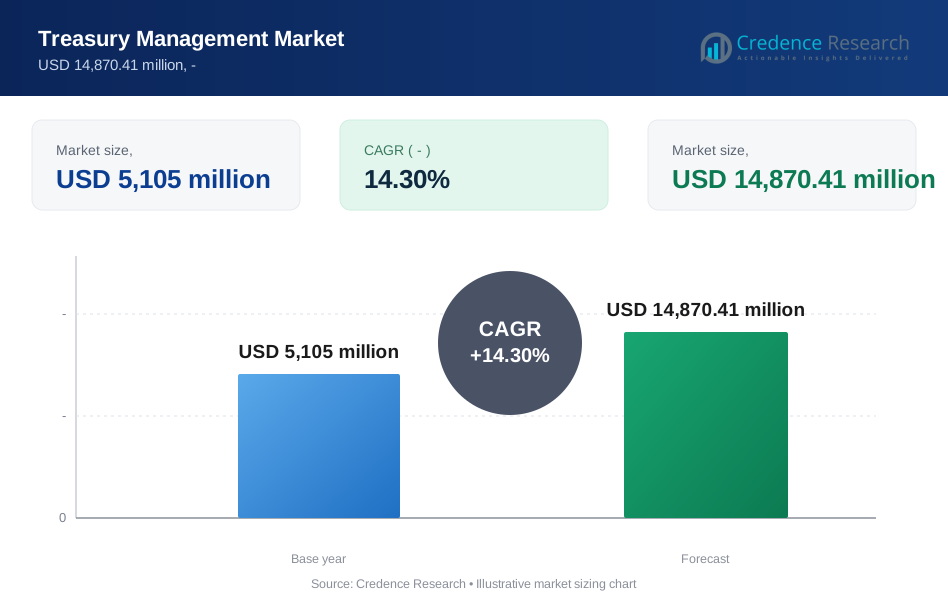
The Treasury Management Market is projected to grow significantly, with a market size of USD 5,105 million in 2024, expected to reach USD 14,870.41 million by 2032, reflecting a CAGR of 14.30% during the forecast period. Treasury management solutions are becoming increasingly essential as businesses seek better control over their liquidity, manage cash flows, and optimize working capital. The growing complexity of financial operations and the need for compliance with global regulatory frameworks are pushing firms to adopt advanced treasury management systems (TMS) to enhance operational efficiency, reduce risks, and improve decision-making.
Key drivers of this market include the increasing demand for real-time financial visibility, driven by the rise in digital transactions and globalization of financial operations. Many organizations are also leveraging cloud-based treasury management solutions, which offer greater scalability, flexibility, and cost-efficiency. Furthermore, growing concerns over cybersecurity and the need to mitigate fraud are encouraging companies to invest in secure, integrated treasury platforms. The adoption of artificial intelligence (AI) and machine learning (ML) within these systems is enabling predictive analytics, helping firms better forecast and manage liquidity risks.
From a regional perspective, North America dominates the treasury management market, accounting for the largest share due to its mature financial ecosystem, high adoption of advanced technologies, and presence of major TMS providers. Europe follows closely, driven by strict regulatory requirements and the need for businesses to streamline financial processes. The Asia-Pacific region is expected to witness the fastest growth due to the rapid digitization of financial services in countries like China, India, and Japan, coupled with increasing demand for automation in treasury functions. Expanding businesses and cross-border transactions in emerging economies further boost the adoption of treasury management solutions in these regions.
Market Drivers:
Growing Need for Real-Time Financial Visibility:
One of the primary drivers of the Treasury Management Market is the increasing demand for real-time financial visibility and control over liquidity. Businesses today operate in a fast-paced global environment where access to accurate and up-to-date financial information is crucial for making timely decisions. For instance, large corporations like General Electric and IBM rely on real-time treasury management systems (TMS) to monitor cash positions, streamline cash flows, and manage liquidity risks across multiple regions and currencies. These systems provide a consolidated view of financial data, enabling better decision-making and improved financial performance.
Adoption of Cloud-Based Solutions:
The shift towards cloud-based treasury management solutions is another key driver, as companies seek scalable and flexible platforms that can support their growing financial operations. Cloud solutions offer numerous advantages, such as lower upfront costs, ease of integration with other financial systems, and enhanced security features. For example, companies like Microsoft and Oracle have introduced cloud-based treasury management platforms that allow businesses to manage global cash positions, perform inter-company netting, and ensure compliance with regulatory standards. The ability to access real-time data from any location enables businesses to optimize cash flow management and better respond to market changes.
Enhanced Security and Fraud Prevention:
As digital financial transactions increase, cybersecurity concerns and the need for robust fraud prevention are driving the adoption of treasury management systems. For instance, treasury management systems with advanced encryption, multi-factor authentication, and AI-powered fraud detection algorithms are becoming critical for mitigating financial risks. Companies such as SAP and FIS are integrating AI-driven security features into their TMS platforms to help businesses detect and prevent fraudulent activities, ensuring the protection of financial assets in an increasingly digitalized environment.
Regulatory Compliance and Risk Management:
The growing complexity of global financial regulations is further propelling the adoption of treasury management systems. Organizations need solutions that help them stay compliant with local and international regulations, such as SOX, IFRS, and Basel III. Treasury management platforms offer robust compliance management tools, allowing companies to ensure that their financial operations adhere to regulatory requirements, reducing the risk of non-compliance penalties. Leading firms like Bloomberg and Kyriba offer treasury solutions that streamline regulatory reporting and automate compliance checks, helping businesses manage risks efficiently across their global operations.
Market Trends:
Increased Focus on Automation and Artificial Intelligence:
One of the prominent trends in the Treasury Management Market is the growing integration of automation and artificial intelligence (AI) into treasury functions. Companies are increasingly using AI-driven tools to automate repetitive tasks such as cash forecasting, reconciliation, and inter-company transactions. For instance, multinational corporations like Unilever and Johnson & Johnson have implemented AI-based treasury solutions that improve the accuracy and efficiency of financial operations. By automating these processes, businesses reduce human error, enhance decision-making, and allocate resources more effectively.
Shift Towards Data-Driven Decision Making:
The emphasis on data-driven decision-making is reshaping treasury management practices. Treasury systems now leverage advanced data analytics to provide detailed insights into cash positions, liquidity risks, and investment opportunities. For example, companies like Bloomberg and Kyriba have developed analytics-driven platforms that offer treasurers real-time access to financial data, enabling more informed and strategic decisions. These tools allow organizations to simulate various financial scenarios and prepare for market fluctuations, enhancing risk management and capital allocation.
Integration of Blockchain Technology:
The adoption of blockchain technology is becoming a significant trend in treasury management, especially in cross-border transactions and supply chain financing. Blockchain offers a secure, decentralized ledger for verifying and recording financial transactions, reducing the need for intermediaries and lowering transaction costs. For instance, HSBC and IBM have both integrated blockchain technology into their treasury management systems to facilitate faster, more secure international payments. This technology enhances transparency and reduces the risk of fraud, making it an attractive option for global businesses.
Growing Adoption of Mobile Treasury Platforms:
The rising demand for mobile treasury management platforms reflects the shift towards more flexible and real-time financial oversight. Treasurers and financial managers are increasingly utilizing mobile applications to monitor cash flow, approve payments, and manage investments on the go. For example, firms like FIS and Oracle offer mobile treasury solutions that provide real-time access to financial data, enabling decision-makers to manage liquidity and treasury functions from any location. This trend is particularly beneficial for businesses with geographically dispersed operations, enhancing accessibility and operational efficiency.
Market Challenges Analysis:
High Implementation and Maintenance Costs:
One of the major challenges in the Treasury Management Market is the high cost of implementation and maintenance of advanced treasury systems. Adopting modern treasury management solutions often requires substantial upfront investments in software, infrastructure, and integration with existing systems. Additionally, ongoing maintenance, updates, and customization add to the financial burden, making it difficult for small and medium-sized enterprises (SMEs) to justify the costs. Larger organizations may also face challenges when scaling their systems to manage complex global operations, further increasing the financial strain.
Integration with Legacy Systems:
Integrating treasury management solutions with legacy financial systems poses another significant restraint. Many companies, especially those with long-standing operations, rely on outdated ERP systems and banking infrastructures. Integrating new treasury platforms with these legacy systems can be a complex and time-consuming process, often requiring specialized expertise and additional resources. This challenge slows the adoption of advanced treasury solutions, particularly in traditional sectors like manufacturing and healthcare.
Data Security and Privacy Concerns:
As treasury management systems become more digitized and cloud-based, data security and privacy concerns have become critical issues. Treasury platforms handle sensitive financial data, including corporate cash flows, investments, and transaction histories. Any breach in these systems can result in significant financial and reputational damage. For instance, industries such as banking and finance face heightened risks from cyberattacks, making secure data encryption, compliance with regulatory frameworks, and fraud prevention crucial. These security concerns increase the complexity and cost of treasury system deployments, limiting broader adoption in highly regulated sectors.
Regulatory Compliance:
Navigating the complexities of global regulatory requirements is another challenge. Companies operating in multiple countries must ensure compliance with different local and international financial regulations, such as SOX, IFRS, and Basel III. Staying compliant adds operational complexity and increases costs for treasury management systems, particularly for organizations with global operations.
Market Segmentation Analysis:
By Type, the market is segmented into Treasury and Risk Management Systems (TRMS), Cash and Liquidity Management Systems, Corporate Treasury Solutions, and Integrated Financial Solutions. TRMS holds a significant share as it provides comprehensive tools for managing cash flow, optimizing liquidity, and minimizing financial risks. With growing complexities in global markets, demand for integrated financial solutions that consolidate various treasury functions is on the rise, ensuring seamless operations across regions.
By Technology, the market is categorized into Cloud-Based Solutions and On-Premises Solutions. Cloud-based solutions dominate the segment due to their scalability, lower implementation costs, and flexibility. Companies increasingly favour cloud-based platforms for their real-time data access and the ability to integrate with other financial systems, offering enhanced efficiency and collaboration, especially for businesses operating in multiple countries.
By End User, the market serves sectors such as BFSI (Banking, Financial Services, and Insurance), Manufacturing, Healthcare, Retail, and Government. The BFSI sector leads the market, driven by the need for sophisticated financial management tools to handle large volumes of transactions and regulatory compliance. The healthcare and retail industries are also witnessing significant adoption as they seek to improve cash management and ensure compliance with regulatory requirements.
Segmentations:
- By Component:
- Software
- Cash Flow Management Software
- Risk Management Software
- Liquidity Management Software
- Payment Management Software
- Debt and Investment Management Software
- Services
- Consulting and Advisory Services
- Implementation and Integration Services
- Support and Maintenance Services
- Software
- By Deployment Mode:
- On-Premises
- Cloud-Based
- By Enterprise Size:
- Small and Medium-sized Enterprises (SMEs)
- Large Enterprises
- By End-Use Industry:
- IT and Telecom
- BFSI
- Retail
- Healthcare
- Government & Public Sector
- Manufacturing
- Others (Consumer Goods, Energy and Utilities and Others)
- By Region:
- North America
- U.S.
- Canada
- Mexico
- Europe
- Germany
- France
- U.K.
- Italy
- Spain
- Rest of Europe
- Asia Pacific
- China
- Japan
- India
- South Korea
- South-east Asia
- Rest of Asia Pacific
- Latin America
- Brazil
- Argentina
- Rest of Latin America
- Middle East & Africa
- GCC Countries
- South Africa
- Rest of the Middle East and Africa
- North America
Regional Analysis:
North America
North America holds the largest share of the Treasury Management Market, accounting for approximately 40% of the global market. This region's dominance is primarily driven by the presence of advanced financial systems and major corporate players adopting treasury management solutions. The high level of digital transformation in the United States and Canada, particularly in sectors such as banking, financial services, and insurance (BFSI), accelerates the demand for sophisticated treasury management systems (TMS). Companies in North America are increasingly utilizing cloud-based solutions to manage their liquidity, cash flows, and financial risk, contributing to significant market growth. Furthermore, stringent regulatory requirements in the U.S., such as SOX compliance, make treasury systems essential for managing financial reporting and risk mitigation.
Europe
Europe accounts for approximately 30% of the global treasury management market. The region's market is fueled by increasing regulatory pressure, especially in compliance with frameworks like MiFID II and Basel III. Countries such as Germany, France, and the United Kingdom are leading the adoption of advanced treasury solutions, particularly in industries like manufacturing, healthcare, and automotive, which require robust cash management and risk mitigation strategies. European businesses also focus on data security and compliance, driving demand for systems with built-in security features to manage complex treasury operations efficiently. The rise of digital banking and fintech innovations in the region further bolsters market growth.
Asia-Pacific
The Asia-Pacific region is expected to witness the fastest growth, with a projected market share of around 20%. Countries like China, India, Japan, and Australia are driving this growth, thanks to the rapid digital transformation in their financial sectors. The increasing adoption of cloud-based treasury management solutions across industries and the region’s growing focus on automation and data analytics are key factors contributing to the market's expansion. Government initiatives to modernize financial infrastructure in emerging economies like India, along with the increasing globalization of businesses in the region, are further accelerating the demand for treasury management solutions.
Latin America, Middle East, and Africa (LAMEA)
Latin America, the Middle East, and Africa (LAMEA) collectively hold approximately 10% of the global market share. The demand for treasury management solutions in these regions is gradually growing as businesses seek to improve cash flow management and regulatory compliance. In Latin America, countries like Brazil and Mexico are adopting advanced financial management tools, particularly in the BFSI sector. In the Middle East & Africa, government initiatives to enhance digital infrastructure and increase investments in treasury solutions for oil and gas and public sectors are contributing to steady market growth. However, challenges such as limited technological infrastructure and a lack of skilled professionals in some areas remain obstacles to faster adoption.
Key Player Analysis:
- Kyriba Corporation
- SAP SE
- Oracle Corporation
- FIS (Fidelity National Information Services, Inc.)
- Finastra
- SAS Institute Inc.
- Wolters Kluwer N.V.
- Broadridge Financial Solutions, Inc.
- Murex S.A.S.
- ION Treasury
Competitive Analysis:
The Treasury Management Market is highly competitive, with key players such as Kyriba, SAP, and Oracle leading the space by offering comprehensive and scalable treasury solutions. These companies leverage cloud-based platforms, artificial intelligence (AI), and machine learning (ML) to enhance cash flow forecasting, risk management, and liquidity optimization. FIS and Finastra also hold significant market positions, focusing on end-to-end financial management solutions tailored to sectors like BFSI, manufacturing, and healthcare. Competition is driven by increasing demand for automation, regulatory compliance, and data security, with companies differentiating themselves through technological innovations and integration capabilities. Smaller players, such as Murex and ION Treasury, focus on niche markets, offering specialized solutions for risk management and financial analytics. Overall, the market is marked by rapid technological advancement and a strong focus on improving operational efficiency and financial transparency for global enterprises.
Recent Developments:
- Kyriba announced in 2023 the launch of 24 new ERP API connectors designed to improve real-time payments, liquidity management, and resiliency for enterprises. These connectors enhance integration with platforms like SAP and Oracle, enabling businesses to automate processes more efficiently and ensure seamless treasury operations amidst global disruptions.
- In 2022, Finastra partnered with EcoTree to offer clients an opportunity to offset their carbon footprint by participating in sustainable forestry projects. This initiative reflects the growing demand for environmentally responsible solutions in treasury management, allowing organizations to align their operations with sustainability goals while optimizing treasury functions.
- FIS introduced enhanced fraud detection and compliance solutions in 2023 as part of its cloud-based treasury management platform. These innovations aim to address the rising risks of cyber threats and regulatory complexities in global financial operations, particularly benefiting clients in the banking and financial services sectors.
- In 2024, Microsoft and Finastra expanded their Banking as a Service (BaaS) collaboration to provide improved lending solutions for small and medium enterprises (SMEs). This partnership enables better access to finance for SMEs by integrating advanced treasury tools with lending capabilities, helping underserved businesses navigate financial challenges more effectively.
Market Concentration & Characteristics:
The Treasury Management Market is moderately concentrated, with a few key players like Kyriba, SAP, Oracle, FIS, and Finastra dominating the landscape. These major providers offer comprehensive, cloud-based treasury solutions tailored for large global corporations, leveraging advanced technologies such as artificial intelligence (AI), machine learning (ML), and real-time data integration. The market is characterized by increasing competition in areas such as automation, fraud prevention, and regulatory compliance. Smaller and emerging players focus on niche solutions or specialized functionalities like cash flow forecasting, risk management, or mobile treasury platforms. However, the demand for integrated, scalable solutions has spurred acquisitions and strategic partnerships, further consolidating the market. Additionally, the rise of cloud-based platforms has enhanced the flexibility, security, and cost-effectiveness of treasury management systems, allowing players to differentiate themselves through innovation and customer-centric solutions.
Report Coverage:
The research report offers an in-depth analysis based on Component, Deployment Mode, Enterprise Size, and End-Use Industry. It details leading market players, providing an overview of their business, product offerings, investments, revenue streams, and key applications. Additionally, the report includes insights into the competitive environment, SWOT analysis, current market trends, as well as the primary drivers and constraints. Furthermore, it discusses various factors that have driven market expansion in recent years. The report also explores market dynamics, regulatory scenarios, and technological advancements that are shaping the industry. It assesses the impact of external factors and global economic changes on market growth. Lastly, it provides strategic recommendations for new entrants and established companies to navigate the complexities of the market.
Future Outlook:
- The adoption of cloud-based treasury management systems will continue to grow as companies seek scalable, cost-efficient solutions to manage liquidity and risks globally.
- Artificial intelligence (AI) and machine learning (ML) will increasingly be integrated into treasury platforms, enabling predictive analytics for better cash flow forecasting and risk management.
- Automation will play a key role in streamlining treasury functions such as cash reconciliation, reducing manual errors and increasing efficiency.
- The focus on fraud prevention and cybersecurity will intensify as treasury systems handle more digital transactions, driving demand for secure, real-time monitoring solutions.
- Regulatory compliance will remain a priority, with treasury systems adapting to evolving global standards like Basel III and SOX.
- Mobile treasury platforms will see higher adoption, allowing treasurers to manage cash flows and approve transactions remotely.
- Blockchain technology is expected to become more prevalent, particularly for secure and transparent cross-border transactions.
- Increasing integration of treasury systems with ERP platforms will enable real-time data sharing and enhance decision-making across financial departments.
- The rise of sustainability-focused treasury solutions will drive innovations, aligning treasury management with environmental, social, and governance (ESG) goals.
- Strategic partnerships between treasury management providers and fintech companies will foster more advanced, flexible, and tailored solutions.
Request a Free Sample
Fill in your details and we'll send you a free sample report.
- Sample data tables & charts
- Research methodology
Market Dynamics
Growing Need for Real-Time Financial Visibility
Businesses require immediate access to accurate financial data to make timely decisions, manage liquidity, and optimize cash flows in a globalized, fast-paced environment. Treasury management systems provide consolidated, real-time views of financial positions, enabling better risk management and operational efficiency.
Adoption of Cloud-Based Solutions
Organizations are increasingly shifting to cloud-based treasury management platforms for their scalability, flexibility, and cost-effectiveness. Cloud solutions enable seamless integration with other financial systems, real-time data access, and support for geographically dispersed operations.
Enhanced Security and Fraud Prevention
With the rise in digital transactions, companies face greater risks of cyber threats and fraud. Advanced treasury management systems offer robust security features such as encryption, multi-factor authentication, and AI-powered fraud detection, which are critical for protecting sensitive financial data.
Regulatory Compliance and Risk Management
The complexity of global financial regulations drives the need for treasury solutions that automate compliance and streamline regulatory reporting. These systems help organizations adhere to standards like SOX, IFRS, and Basel III, reducing the risk of non-compliance and associated penalties.
Integration of Automation and Artificial Intelligence
Automation and AI are increasingly embedded in treasury management systems to streamline repetitive tasks, improve cash forecasting, and enhance decision-making. This reduces manual errors, increases efficiency, and allows treasury teams to focus on strategic activities.
Need a Custom Version of This Report?
Tailor the scope, geography, or segments to your exact requirements.
- Custom geography or segment scope
- Direct access to our analyst team
Frequently Asked Questions
What is the current size of the Treasury Management Market?
What factors are driving the growth of the Treasury Management Market?
What are some challenges faced by the Treasury Management Market?
Who are the major players in the Treasury Management Market?
Which segment is leading the market share?
Table of Content
Chapter 1 Market Segmentation
- 1.1 Segmentation Framework
- 1.1.1 Product and Service Classification
- 1.1.2 Application and End-Use Classification
- 1.1.3 Technology and Solution Classification
- 1.1.4 Customer and Distribution Channel Classification
- 1.1.5 Geographic Segmentation
- 1.1.6 Market Segment Definitions and Boundaries
- 1.2 By Component
- 1.2.1 Software
- 1.2.2 Services
- 1.3 By Deployment Mode
- 1.3.1 On-Premises
- 1.3.2 Cloud-Based
- 1.4 By Enterprise Size
- 1.4.1 Small and Medium-sized Enterprises (SMEs)
- 1.4.2 Large Enterprises
- 1.5 By End-Use Industry
- 1.5.1 BFSI
- 1.5.2 Manufacturing
- 1.5.3 Healthcare
- 1.5.4 Retail
- 1.5.5 Government & Public Sector
- 1.5.6 IT and Telecom
Chapter 2 Introduction
- 2.1 Report Objectives and Scope
- 2.2 Product Definition and Industry Terminology
- 2.3 Market Inclusions and Exclusions
- 2.4 Research Process
- 2.4.1 Primary Research and Expert Interviews
- 2.4.2 Secondary Research and Source Review
- 2.4.3 Top-Down and Bottom-Up Estimation
- 2.4.4 Data Triangulation and Verification
- 2.5 Market Size Measurement Basis
- 2.5.1 2024: USD 5,105 million → 2032: USD 14,870.41 million
- 2.6 Historical and Forecast Reference Periods
- 2.6.1 Base Year: 2024
- 2.6.2 Forecast Period: 2024-2032
- 2.7 Research Assumptions and Limitations
Chapter 3 Executive Summary
- 3.1 Market Snapshot and Key Findings
- 3.2 Base-Year Market Size, 2024
- 3.3 Forecast Market Size, 2032
- 3.4 Revenue and Volume Growth Outlook
- 3.5 Key Demand and Supply Indicators
- 3.6 Leading Market Segments
- 3.7 Fastest-Growing Market Opportunities
- 3.8 Regional Performance Highlights
- 3.9 Technology and Industry Transformation
- 3.10 Competitive Landscape Summary
- 3.11 Analyst View and Strategic Implications
Chapter 4 Global Treasury Management Market Trends and Developments
- 4.1 Historical Industry Development
- 4.2 Recent Market Trends and Developments
- 4.3 Demand and Customer Behavior Trends
- 4.4 Technology and Product Innovation
- 4.5 Artificial Intelligence, Automation and Digitalization
- 4.6 Local Manufacturing and Supply Chain Realignment
- 4.7 Industry Partnerships, Mergers and Acquisitions
- 4.8 Sustainability and Circular Economy Developments
- 4.9 Government and Private Sector Investment Trends
- 4.10 Emerging Business Models and Commercialization
- 4.11 Industry Developments and Announcements
Chapter 5 Global Treasury Management Market Production, Supply and Demand Analysis
- 5.1 Demand Trend and Consumption Analysis
- 5.2 Demand Forecast, 2024-2032
- 5.3 Production and Output Trend
- 5.4 Production and Output Forecast, 2024-2032
- 5.5 Installed Capacity and Capacity Utilization
- 5.6 Company-Wise Production Plants and Statistics
- 5.6.1 Installed Production Capacity
- 5.6.2 Actual Production
- 5.6.3 Planned Capacity and Expansion Targets
- 5.7 Supply Chain Structure and Procurement Trends
- 5.8 Supply-Demand Gap and Bottlenecks
- 5.9 Import Dependence and Sourcing Structure
- 5.10 Contract Manufacturing and Outsourcing
- 5.11 Regional Supply and Demand Concentration
Chapter 6 Global Treasury Management Market Pricing Analysis
- 6.1 Pricing Structure and Measurement
- 6.2 Historical Pricing Trends
- 6.3 Pricing Outlook, 2024-2032
- 6.4 Average Selling Price and Unit Economics
- 6.5 Pricing by Product and Market Segment
- 6.6 Geographic Pricing Differences
- 6.7 Key Input, Energy, Labor and Logistics Costs
- 6.8 Contract Pricing and Purchasing Models
- 6.9 Pricing Sensitivity and Competitive Positioning
- 6.10 Price, Margin and Profitability Implications
Chapter 7 Global Treasury Management Market Dynamics
- 7.1 Market Growth Drivers
- 7.1.1 Demand-Side Drivers
- 7.1.2 Technology and Innovation Drivers
- 7.1.3 Infrastructure and Investment Drivers
- 7.1.4 Regulatory and Policy Drivers
- 7.2 Market Restraints
- 7.2.1 Cost and Affordability Constraints
- 7.2.2 Technology and Adoption Barriers
- 7.2.3 Supply Chain and Operational Constraints
- 7.3 Market Challenges
- 7.3.1 Competitive Pressure and Margin Erosion
- 7.3.2 Skills, Infrastructure and Implementation Gaps
- 7.4 Emerging Market Opportunities
- 7.5 Market Dynamics Impact and Time-Horizon Assessment
Chapter 8 Global Treasury Management Value Chain Analysis
- 8.1 Industry Value Chain Overview
- 8.2 Upstream Suppliers and Critical Inputs
- 8.3 Technology and Component Providers
- 8.4 Manufacturing or Service Delivery
- 8.5 Distribution, Channel Partners and Integrators
- 8.6 Downstream Applications and End Users
- 8.7 Value Addition and Profit Pools
- 8.8 Vertical Integration and Outsourcing
- 8.9 Supplier Concentration and Risk
- 8.10 Supply Chain Localization and Resilience
Chapter 9 Global Treasury Management Market Regulations and Policies
- 9.1 Relevant Laws, Standards and Compliance Frameworks
- 9.2 Product, Service, Safety and Quality Requirements
- 9.3 Government Policies, Incentives and Subsidies
- 9.4 Imports, Exports and Trade Barriers
- 9.5 Public Procurement and Local Content Requirements
- 9.6 Environmental and Sustainability Compliance
- 9.7 Data Protection, AI and Cybersecurity Compliance
- 9.8 Upcoming Policy Changes and Market Implications
Chapter 10 Global Treasury Management Market Hotspots and Opportunities
- 10.1 Market Opportunity Mapping and Growth Hotspots
- 10.2 High-Growth Applications and Customer Groups
- 10.3 Underserved Markets and White-Space Opportunities
- 10.4 Emerging Technology and Product Opportunities
- 10.5 New Capacity and Investment Hotspots
- 10.6 Market Entry and Expansion Opportunities
- 10.7 Distribution and Partnership Opportunities
- 10.8 Near-Term and Long-Term Commercial Potential
- 10.9 Opportunity Attractiveness and Execution Risks
Chapter 11 Global Treasury Management Market Outlook, 2024-2032
- 11.1 Market Size and Analysis
- 11.1.1 Revenue (Market Measurement: 2024: USD 5,105 million → 2032: USD 14,870.41 million)
- 11.1.2 Market Volume and Quantity Sold
- 11.1.3 Historical Market Size
- 11.1.4 Base-Year Market Size, 2024
- 11.2 Market Forecast, 2024-2032
- 11.2.1 Revenue Forecast to 2032
- 11.2.2 Volume Forecast to 2032
- 11.2.3 CAGR and Year-on-Year Growth
- 11.2.4 Incremental Revenue Opportunity
- 11.3 Forecast Assumptions and Scenario Analysis
- 11.3.1 Base-Case Forecast
- 11.3.2 Optimistic and Conservative Scenarios
- 11.3.3 Technology, Pricing and Policy Sensitivities
- 11.4 Market Attractiveness and Growth Outlook
Chapter 12 Global Treasury Management Market Segmentation and Outlook
- 12.1 Segmentation Summary and Market Shares, 2024
- 12.2 Largest and Fastest-Growing Segments
- 12.3 By Component - Market Size and Forecast, 2024-2032
- 12.3.1 Segment Definition and Scope
- 12.3.2 Historical Market Size
- 12.3.3 Revenue Forecast, 2024-2032
- 12.3.4 Volume Forecast, 2024-2032
- 12.3.5 Base-Year Market Share, 2024
- 12.3.6 Segment CAGR and Growth Drivers
- 12.3.7 Subsegment Market Size and Forecast
- 12.3.7.1 Software
- 12.3.7.2 Services
- 12.3.8 Subsegment Pricing and Adoption Trends
- 12.3.9 Leading Suppliers and Competition
- 12.3.10 Regional Demand and Opportunities
- 12.4 By Deployment Mode - Market Size and Forecast, 2024-2032
- 12.4.1 Segment Definition and Scope
- 12.4.2 Historical Market Size
- 12.4.3 Revenue Forecast, 2024-2032
- 12.4.4 Volume Forecast, 2024-2032
- 12.4.5 Base-Year Market Share, 2024
- 12.4.6 Segment CAGR and Growth Drivers
- 12.4.7 Subsegment Market Size and Forecast
- 12.4.7.1 On-Premises
- 12.4.7.2 Cloud-Based
- 12.4.8 Subsegment Pricing and Adoption Trends
- 12.4.9 Leading Suppliers and Competition
- 12.4.10 Regional Demand and Opportunities
- 12.5 By Enterprise Size - Market Size and Forecast, 2024-2032
- 12.5.1 Segment Definition and Scope
- 12.5.2 Historical Market Size
- 12.5.3 Revenue Forecast, 2024-2032
- 12.5.4 Volume Forecast, 2024-2032
- 12.5.5 Base-Year Market Share, 2024
- 12.5.6 Segment CAGR and Growth Drivers
- 12.5.7 Subsegment Market Size and Forecast
- 12.5.7.1 Small and Medium-sized Enterprises (SMEs)
- 12.5.7.2 Large Enterprises
- 12.5.8 Subsegment Pricing and Adoption Trends
- 12.5.9 Leading Suppliers and Competition
- 12.5.10 Regional Demand and Opportunities
- 12.6 By End-Use Industry - Market Size and Forecast, 2024-2032
- 12.6.1 Segment Definition and Scope
- 12.6.2 Historical Market Size
- 12.6.3 Revenue Forecast, 2024-2032
- 12.6.4 Volume Forecast, 2024-2032
- 12.6.5 Base-Year Market Share, 2024
- 12.6.6 Segment CAGR and Growth Drivers
- 12.6.7 Subsegment Market Size and Forecast
- 12.6.7.1 BFSI
- 12.6.7.2 Manufacturing
- 12.6.7.3 Healthcare
- 12.6.7.4 Retail
- 12.6.7.5 Government & Public Sector
- 12.6.7.6 IT and Telecom
- 12.6.8 Subsegment Pricing and Adoption Trends
- 12.6.9 Leading Suppliers and Competition
- 12.6.10 Regional Demand and Opportunities
- 12.7 Segment Growth Comparison
- 12.8 Segment Attractiveness and Priority Matrix
Chapter 13 Global Treasury Management End-Use and Application Market Outlook
- 13.1 End-Use Industry and Customer Demand Structure
- 13.2 Leading Applications and Customer Groups
- 13.3 End-Use Market Size, Share and Forecast
- 13.4 Major End-Use Industry Deep Dives
- 13.4.1 Customer Requirements and Use Cases
- 13.4.2 Demand and Replacement Cycles
- 13.4.3 Technical and Regulatory Considerations
- 13.4.4 Purchasing and Procurement Models
- 13.4.5 Leading Vendors and Distribution Channels
- 13.4.6 Forecast and Commercial Opportunities
- 13.5 Emerging Applications and Cross-Segment Demand
- 13.6 End-Use Industry Investment Priorities
Chapter 14 Global Treasury Management Geographic Market Outlook, 2024-2032
- 14.1 Regional Market Size and Share, 2024
- 14.2 Regional Market Forecast, 2024-2032
- 14.3 Regional Pricing, Production and Demand Differences
- 14.4 North America
- 14.4.1 United States
- 14.4.2 Canada
- 14.4.3 Mexico
- 14.5 Europe
- 14.5.1 Germany
- 14.5.2 France
- 14.5.3 Italy
- 14.5.4 United Kingdom
- 14.5.5 Spain
- 14.5.6 Poland
- 14.5.7 Russia
- 14.5.8 Netherlands
- 14.5.9 Belgium
- 14.5.10 Sweden
- 14.5.11 Denmark
- 14.5.12 Norway
- 14.5.13 Rest of Europe
- 14.6 Asia Pacific
- 14.6.1 China
- 14.6.2 India
- 14.6.3 Japan
- 14.6.4 South Korea
- 14.6.5 Thailand
- 14.6.6 Indonesia
- 14.6.7 Vietnam
- 14.6.8 Malaysia
- 14.6.9 Australia
- 14.6.10 Rest of Asia Pacific
- 14.7 Latin America
- 14.7.1 Brazil
- 14.7.2 Argentina
- 14.7.3 Colombia
- 14.7.4 Chile
- 14.7.5 Rest of Latin America
- 14.8 Middle East
- 14.8.1 Saudi Arabia
- 14.8.2 United Arab Emirates
- 14.8.3 Turkey
- 14.8.4 Israel
- 14.8.5 Iran
- 14.8.6 Rest of the Middle East
- 14.9 Africa
- 14.9.1 South Africa
- 14.9.2 Egypt
- 14.9.3 Nigeria
- 14.9.4 Morocco
- 14.9.5 Rest of Africa
- 14.10 Regional Investment, Policy and Supply Chain Differences
- 14.11 Regional Competitive Landscape
- 14.12 Geographic Growth Hotspots
Chapter 15 Global Treasury Management Technology, Innovation and Sustainability Outlook
- 15.1 Technology Landscape and Maturity
- 15.2 Product, Process and Service Innovation
- 15.3 AI, Automation and Digital Tools in the Industry
- 15.4 Technology Adoption and Performance Benchmarking
- 15.5 Innovation Pipeline and R&D Investment
- 15.6 Patent and Intellectual Property Trends
- 15.7 Energy Efficiency and Resource Management
- 15.8 Sustainability, Recycling and Circularity
- 15.9 Technology Roadmap, 2024-2032
- 15.10 Risks of Obsolescence and Technology Substitution
Chapter 16 Global Treasury Management Market Key Strategic Imperatives
- 16.1 Growth and Market Entry Priorities
- 16.2 High-Return Products and Segments
- 16.3 Pricing, Profitability and Cost Optimization
- 16.4 Technology Investment and Product Differentiation
- 16.5 Supply Chain Localization and Resilience
- 16.6 Distribution and Customer Acquisition
- 16.7 Partnership, Acquisition and Capacity Strategy
- 16.8 Regional Expansion Priorities
- 16.9 Short-, Medium- and Long-Term Actions
Chapter 17 Competition Outlook
- 17.1 Industry Competition Characteristics
- 17.2 Market Structure and Concentration
- 17.3 Market Share and Competitive Positioning, 2024
- 17.4 Company-Wise Revenue and Product Benchmarking
- 17.5 Production and Service Capacity Benchmarking
- 17.6 Technology, Pricing and Differentiation
- 17.7 Regional Footprint and Distribution Strength
- 17.8 Mergers, Acquisitions and Strategic Alliances
- 17.9 New Entrants and Competitive Threats
- 17.10 Porter's Five Forces and Industry Attractiveness
- 17.11 Competitive Outlook, 2024-2032
Chapter 18 Company Profiles
- 18.1 Company Coverage and Selection Criteria
- 18.2 Kyriba Corporation
- 18.2.1 Business Description
- 18.2.2 Company Ownership and Geographic Presence
- 18.2.3 Product and Service Portfolio
- 18.2.4 Manufacturing and Operating Footprint
- 18.2.5 Production Capacity and Expansion Plans
- 18.2.6 Financial Performance and Investment
- 18.2.7 Market Share and Competitive Position
- 18.2.8 Technology and Innovation Capabilities
- 18.2.9 Strategic Alliances or Partnerships
- 18.2.10 Recent Developments
- 18.2.11 Growth Strategy and Outlook
- 18.3 SAP SE
- 18.4 Oracle Corporation
- 18.5 FIS (Fidelity National Information Services, Inc.)
- 18.6 Finastra
- 18.7 SAS Institute Inc.
- 18.8 Wolters Kluwer N.V.
- 18.9 Broadridge Financial Solutions, Inc.
- 18.10 Murex S.A.S.
- 18.11 ION Treasury
- 18.12 Other Relevant Market Participants
Note: Every listed company is profiled on the structure shown under the first company. The company list is preliminary and may change based on research findings, market developments, data availability and client requirements.
Chapter 19 Disclaimer
- 19.1 Research and Forecast Disclaimer
- 19.2 Data Source and Estimation Limitations
Note: The depth of individual sections depends on data availability for this market. Volume, capacity, trade and other unit-based metrics are included where applicable.