
Market Overview:
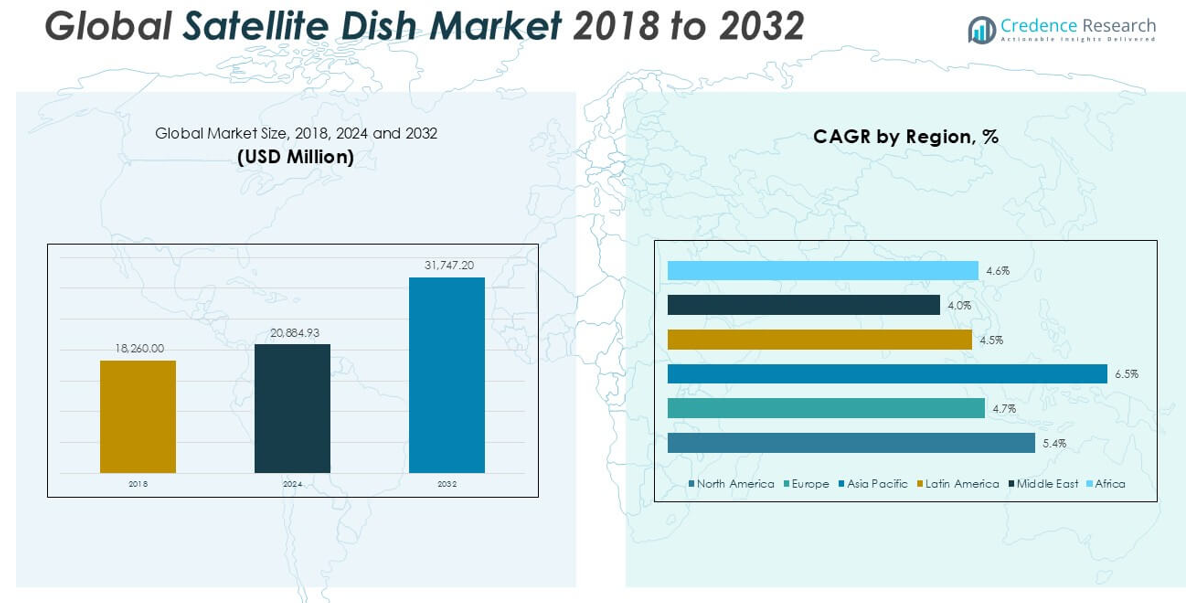
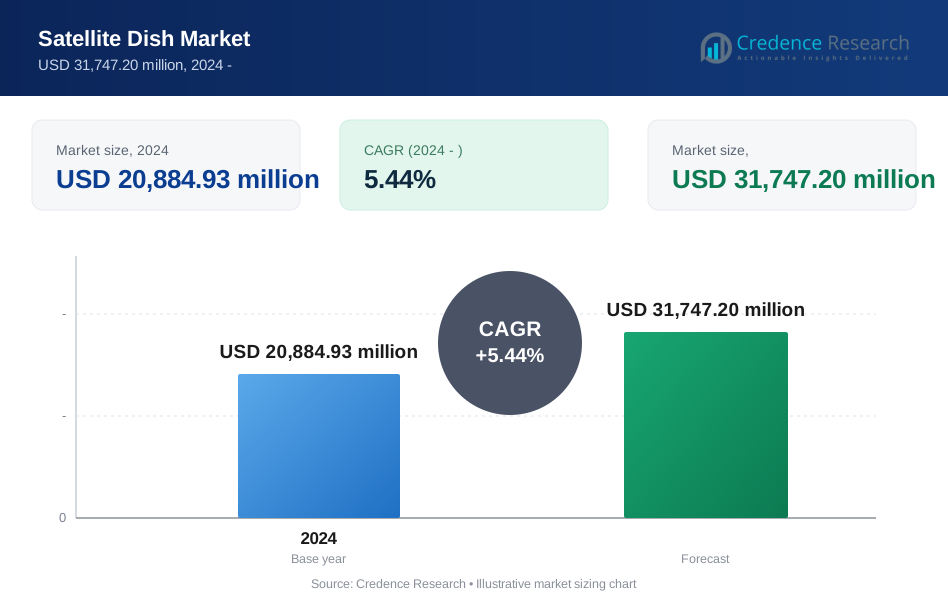
The Satellite Dish market size was valued at USD 18,260.00 million in 2018, increased to USD 20,884.93 million in 2024, and is anticipated to reach USD 31,747.20 million by 2032, growing at a CAGR of 5.44% during the forecast period.
| REPORT ATTRIBUTE | DETAILS |
|---|---|
| Historical Period | 2020-2023 |
| Base Year | 2024 |
| Forecast Period | 2025-2032 |
| Satellite Dish Market Size 2024 | USD 20,884.93 million |
| Satellite Dish Market, CAGR | 5.44% |
| Satellite Dish Market Size 2032 | USD 31,747.20 million |
The Satellite Dish market is led by prominent players such as ViaSat, Hughes Network Systems, Gilat Satellite Networks, iDirect, Kymeta, ThinKom, and Ubiquiti Networks, each offering advanced satellite communication technologies catering to residential, commercial, and defense applications. These companies focus on expanding their product portfolios, integrating smart technologies, and supporting high-throughput satellite networks. North America emerges as the leading regional market, holding a dominant 35.35% share in 2024, driven by strong demand for DTH services, satellite broadband deployment, and robust defense communication infrastructure. Asia Pacific follows, supported by high growth in emerging markets and rising investments in digital connectivity initiatives.
Market Insights
- The Satellite Dish market was valued at USD 20,884.93 million in 2024 and is projected to reach USD 31,747.20 million by 2032, growing at a CAGR of 5.44% during the forecast period.
- Growth is primarily driven by the rising demand for direct-to-home (DTH) television services, increasing satellite broadband usage, and expanding defense and government communication needs globally.
- Technological trends such as the adoption of smart satellite dishes, flat-panel antennas, and integration with low-earth orbit (LEO) satellite networks are shaping product innovations and future market demand.
- Major players like ViaSat, Hughes Network Systems, iDirect, and Kymeta lead the competitive landscape, with continued focus on product development, strategic partnerships, and LEO connectivity solutions.
- Regionally, North America holds the largest share at 35.35%, followed by Asia Pacific at 28.73%; by type, parabolic dishes dominate the segment due to their reliability and wide application across residential and commercial sectors.
Market Segmentation Analysis:
By Type
Parabolic dishes dominated the satellite dish market in 2024, accounting for the largest market share due to their high signal gain, reliable performance, and widespread use across residential and commercial applications. Their ability to receive and transmit signals over long distances makes them a preferred choice for both television broadcasting and data communications. While flat-panel and offset dishes are gaining traction for their compact design and ease of installation, parabolic dishes continue to lead the market, driven by robust demand in remote and rural areas where cable infrastructure is limited.
- For instance, Hughes Network Systems deployed over 1.5 million parabolic antenna systems globally for its broadband satellite internet services, supporting its Jupiter™ System platform.
By Installation Type
The professional installation segment held the majority market share in 2024, driven by the need for technical accuracy and optimal alignment for maximum signal reception. End-users, especially in commercial and government sectors, often rely on certified technicians to ensure uninterrupted connectivity and regulatory compliance. Despite the growing availability of self-installation kits, their market penetration remains limited due to concerns around complexity and performance inconsistency. The dominance of professional installation is further reinforced by the increasing deployment of satellite internet services and high-throughput satellite systems requiring precise setup.
- For instance, ViaSat has trained and certified over 4,000 professional installers across the U.S. alone to support its residential and government connectivity solutions, ensuring optimal performance of its high-capacity satellites like ViaSat-2 and ViaSat-3.
By End-User Application
Residential users represented the largest market share in the satellite dish market in 2024, primarily due to the continued global demand for direct-to-home (DTH) television services and satellite broadband in underserved areas. The commercial segment also showed strong growth, particularly among hospitality and media industries. However, government and military applications demonstrated stable demand, supported by strategic communication needs and defense modernization programs. Emergency services and disaster recovery, while a niche segment, gained importance in areas prone to natural calamities, as satellite connectivity offers reliable communication when terrestrial networks fail.
Market Overview
Rising Demand for Direct-to-Home (DTH) Services
The rapid expansion of DTH services continues to drive demand for satellite dishes, especially in rural and underserved areas where terrestrial cable infrastructure is limited or absent. Consumers prefer DTH for its wide content access, high-quality transmission, and cost-effective subscription models. Emerging markets across Asia-Pacific, Latin America, and Africa are experiencing increasing DTH adoption due to urbanization, rising disposable incomes, and supportive government initiatives promoting digital inclusion, thereby fueling market growth for satellite dish manufacturers and service providers.
- For instance, Dish TV India Limited surpassed 23.7 million active subscribers by the end of FY2023, supported by its deployment of parabolic dishes and hybrid set-top boxes that extend satellite access to remote regions.
Expanding Satellite Broadband Deployment
The global push for satellite-based internet connectivity, especially in remote or geographically challenging regions, significantly contributes to the satellite dish market. Governments and private players are investing in Low Earth Orbit (LEO) and Geostationary Orbit (GEO) satellite constellations to improve broadband access. Satellite dishes act as essential ground equipment for these services, enabling reliable data transmission. The rise in e-learning, telehealth, and remote work post-pandemic has further intensified the need for robust satellite broadband infrastructure, bolstering dish demand worldwide.
- For instance, Starlink, operated by SpaceX, has deployed over 5,800 satellites in its LEO constellation and shipped more than 2.8 million user terminals (flat, phased-array dishes) worldwide to deliver high-speed internet in over 70 countries as of mid-2024.
Increased Defense and Government Communication Needs
Governments and defense organizations rely on secure, high-capacity communication networks supported by satellite infrastructure. Satellite dishes are crucial for transmitting real-time data, voice, and video, particularly in conflict zones, border areas, and during disaster recovery. The modernization of military communication systems and the deployment of surveillance satellites are amplifying investments in satellite-based communication solutions. As a result, the demand for advanced satellite dishes with high resilience and reliability is expected to grow steadily in the government and military sectors.
Key Trends & Opportunities
Adoption of Smart and Flat-Panel Satellite Dishes
Technological innovation is driving the adoption of smart satellite dishes and flat-panel antennas that offer compact design, auto-alignment, and enhanced mobility. These next-generation dishes are ideal for maritime, aviation, and portable communication applications. Manufacturers are leveraging electronically steered array (ESA) technology to enable faster, seamless connectivity without mechanical parts. This trend opens new growth avenues in mobile connectivity sectors and supports the proliferation of connected vehicles and smart transportation systems.
- For instance, Kymeta’s u8 terminal, a flat-panel, software-defined ESA, operates on Ku-band and enables continuous connectivity with speeds of up to 45 Mbps downlink and 5 Mbps uplink, with successful deployments across military and transportation fleets globally.
Integration with LEO Satellite Networks
The growing launch of LEO satellite constellations by companies like Starlink and OneWeb is transforming the satellite communication landscape. LEO satellites require smaller, lighter, and more responsive ground stations, creating a rising opportunity for satellite dish manufacturers to develop tailored products. These systems enable lower latency and higher-speed connectivity, making them ideal for consumer internet and IoT applications. The evolving network architecture provides manufacturers with a strategic opportunity to cater to a high-growth, technology-driven segment.
- For instance, OneWeb has launched 648 operational LEO satellites as of March 2024, and collaborates with companies like Intellian to manufacture high-performance user terminals that support dynamic tracking and seamless switching between satellites.
Key Challenges
High Installation and Maintenance Costs
Despite their utility, satellite dishes involve significant upfront installation and long-term maintenance costs, which can deter residential users and small businesses. Complex installation procedures often require professional services, while regular calibration and weather-related repairs add to operational expenses. In price-sensitive markets, such costs can limit market penetration, especially when alternative broadband options like fiber optics or 5G are available at competitive rates.
Weather and Environmental Vulnerability
Satellite dishes are highly susceptible to adverse weather conditions such as heavy rain, snow, and storms, which can degrade signal quality or cause service outages. This environmental vulnerability hampers the reliability of satellite communication, particularly in regions with frequent extreme weather events. While technological advancements aim to mitigate these issues, weather-induced disruptions remain a persistent challenge affecting consumer satisfaction and service consistency.
Regulatory and Spectrum Allocation Issues
The satellite communication industry is subject to stringent regulatory frameworks and complex spectrum allocation protocols governed by national and international authorities. Delays in licensing, cross-border frequency conflicts, and evolving compliance standards can hinder market expansion. For satellite dish providers, navigating these regulatory landscapes often requires significant investment in legal and compliance resources, which can slow down time-to-market and innovation efforts.
Regional Analysis
North America
North America held the largest share in the satellite dish market in 2024, accounting for approximately 35.35% of the global market with a value of USD 7,384.79 million, up from USD 6,537.08 million in 2018. The region is projected to reach USD 11,187.40 million by 2032, growing at a CAGR of 5.4% during the forecast period. Market growth is driven by strong demand for DTH services, satellite broadband expansion in rural areas, and extensive government and defense communication needs. The U.S. remains the primary contributor due to advanced infrastructure and early adoption of emerging satellite technologies.
Europe
Europe represented around 24.28% of the global satellite dish market in 2024, with a market size of USD 5,074.47 million, up from USD 4,623.43 million in 2018. The region is expected to reach USD 7,268.61 million by 2032, registering a CAGR of 4.7%. Growth in Europe is supported by the ongoing migration to digital television platforms, rising demand for satellite-based internet in Eastern Europe, and EU-led projects enhancing satellite communications for public services. Countries like Germany, France, and the U.K. are leading the regional market due to strong satellite infrastructure and investment in smart communication systems.
Asia Pacific
Asia Pacific accounted for approximately 28.73% of the global satellite dish market in 2024, valued at USD 6,001.20 million, up from USD 5,048.89 million in 2018. The region is forecasted to reach USD 9,886.67 million by 2032, growing at the highest CAGR of 6.5%. Rapid urbanization, government digital inclusion initiatives, and increasing satellite broadband penetration in countries like India and China are driving growth. The expanding television broadcasting sector and rising investments in space and satellite programs are also fueling demand. Asia Pacific is emerging as a key region for both manufacturing and end-user consumption.
Latin America
Latin America held a 6.25% share in the satellite dish market in 2024, with a market size of USD 1,307.81 million, up from USD 1,154.58 million in 2018. The region is projected to reach USD 1,844.51 million by 2032, growing at a CAGR of 4.5%. Growth is supported by increasing adoption of satellite TV services in rural and underserved regions and government efforts to bridge the digital divide. Brazil and Mexico lead the regional market due to their large populations and expanding media consumption. However, regulatory challenges and economic volatility may restrain market pace in some countries.
Middle East
The Middle East captured 3.34% of the global satellite dish market in 2024, valued at USD 697.42 million, rising from USD 653.71 million in 2018. The market is expected to grow to USD 949.42 million by 2032, at a CAGR of 4.0%. The region’s market is driven by government investments in satellite infrastructure for defense and public broadcasting, particularly in the Gulf Cooperation Council (GCC) countries. Additionally, satellite dishes play a vital role in remote desert areas where terrestrial networks are limited. Despite geopolitical challenges, increasing interest in satellite-based internet services supports long-term market prospects.
Africa
Africa held 2.01% of the global satellite dish market in 2024, with a market value of USD 419.25 million, up from USD 242.31 million in 2018. It is expected to reach USD 610.60 million by 2032, growing at a CAGR of 4.6%. The market is primarily driven by the growing demand for television access in rural regions, where satellite is often the only feasible mode of broadcast. Additionally, international organizations and telecom operators are increasingly investing in satellite connectivity to improve education and healthcare infrastructure. However, affordability and infrastructural challenges may limit rapid expansion in some parts of the continent.
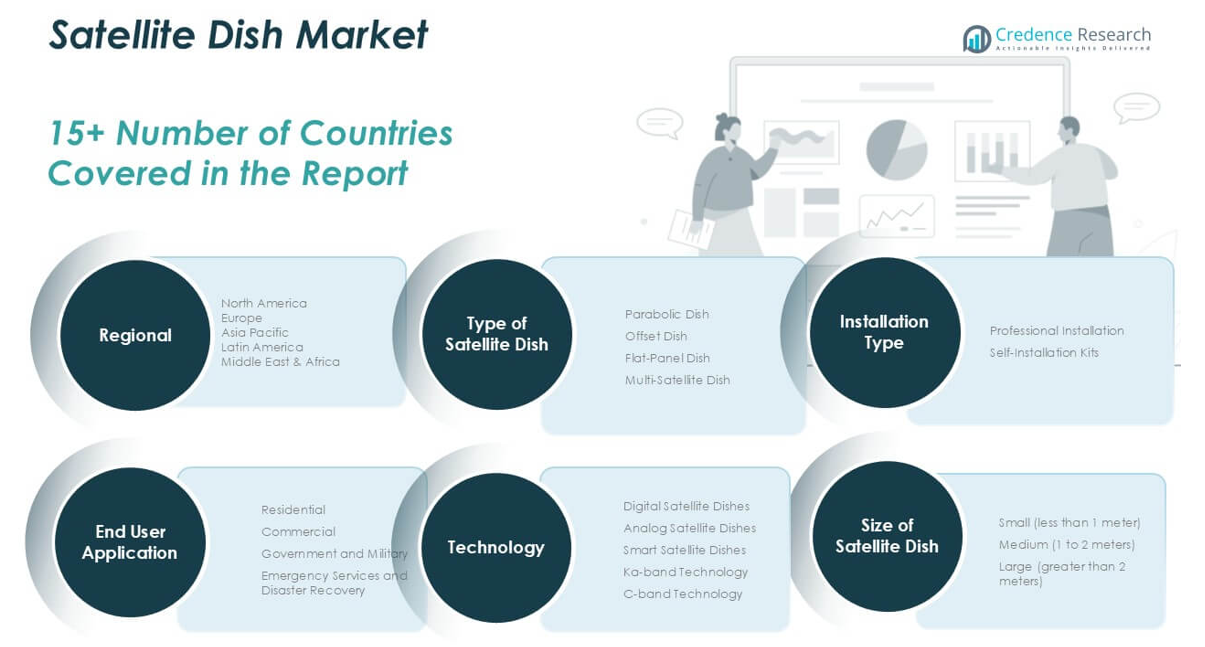
Market Segmentations:
By Type
- Parabolic Dish
- Offset Dish
- Flat-Panel Dish
- Multi-Satellite Dish
By Installation Type
- Professional Installation
- Self-Installation Kits
By End-User Application
- Residential
- Commercial
- Government and Military
- Emergency Services and Disaster Recovery
By Technology
- Digital Satellite Dishes
- Analog Satellite Dishes
- Smart Satellite Dishes
- Ka-band Technology
- C-band Technology
By Size of Satellite Dish
- Small (less than 1 meter)
- Medium (1 to 2 meters)
- Large (greater than 2 meters)
By Geography
- North America
- U.S.
- Canada
- Mexico
- Europe
- Germany
- France
- U.K.
- Italy
- Spain
- Rest of Europe
- Asia Pacific
- China
- Japan
- India
- South Korea
- South-east Asia
- Rest of Asia Pacific
- Latin America
- Brazil
- Argentina
- Rest of Latin America
- Middle East & Africa
- GCC Countries
- South Africa
- Rest of the Middle East and Africa
Competitive Landscape
The satellite dish market features a diverse and competitive landscape comprising established global players and regional manufacturers. Key companies such as ViaSat, Hughes Network Systems, Gilat Satellite Networks, and iDirect dominate the market with advanced technology offerings and broad service portfolios. These companies focus on innovations in flat-panel antennas, electronically steered arrays, and integration with LEO satellite networks to maintain technological leadership. Emerging players like Kymeta and ThinKom are gaining traction by offering lightweight, high-performance satellite dishes tailored for mobility and enterprise applications. Regional manufacturers, including Hebei Linuo Communication Equipment Co. Ltd. and Wuxi Tianqi Communication Equipment Factory, provide cost-effective solutions, especially in price-sensitive markets across Asia and Africa. Strategic partnerships, product upgrades, and mergers and acquisitions remain common competitive strategies. The market is further shaped by growing demand for satellite internet and global coverage, prompting players to invest in R&D and global distribution networks to capture emerging growth opportunities.
Key Player Analysis
- ViaSat
- Vimian: Movora
- Ubiquiti Networks
- KVH
- SVEC
- ThinKom
- Electronic Controlled Systems
- Hughes Network Systems
- iDirect
- Renqiu Sanwei Communication Equipment Co. Ltd.
- Wuxi Tianqi Communication Equipment Factory
- Gilat Satellite Networks
- Kymeta
- Hebei Linuo Communication Equipment Co. Ltd.
- Shenzhen Huaxin Antenna Technology Co. Ltd.
Recent Developments
- In May-June 2025, Ubiquiti focused on enhancing its UniFi and airMAX product lines with Wi-Fi 7 and scalable networking solutions. There were no announcements or releases of dedicated satellite dish hardware, indicating Ubiquiti's primary focus remains on terrestrial wireless infrastructure.
- In May 2025, ViaSat was selected by the U.S. Space Force for Phase 2 of its Enterprise Space Terminal (EST)This phase focuses on developing a new space optical terminal for crosslink communications between orbits, involving advanced prototyping and initial hardware testing of a next-generation space laser communications terminal.
- In April 2025, ViaSat enhanced its multi-orbit service offerings by integrating Telesat's Lightspeed LEO Ka-band capacity. This integration aims to provide highly reliable broadband connectivity, particularly for mobility and government sectors. The multi-orbit approach combines geostationary (GSO) and low Earth orbit (LEO) satellites to offer a more robust and versatile service.
- In May 2025, Viasat's dedicated Arctic broadband payloads, GX10A and GX10B, became operational on Space Norway's satellites. This launch extends high-speed internet coverage to government users in the Arctic region, with commercial services for maritime and aviation sectors planned for fiscal year 2026. The payloads are hosted on the Arctic Satellite Broadband Mission (ASBM) spacecraft, ASBM-1 and ASBM-2.
- In September 2024, KVH's TracVision UHD7 marine satellite TV system was awarded the NMEA Product of Excellence award for its performance in delivering high-quality UHD and 4K satellite TV from multiple providers, according to a press release from KVH Industries. This recognition highlights the system's leadership in maritime entertainment technology. It also marked the 27th consecutive year that a KVH TracVision system has received this honor in the satellite TV category
Market Concentration & Characteristics
The Satellite Dish Market demonstrates moderate concentration, with a mix of global technology leaders and regional manufacturers competing across key segments. Companies such as ViaSat, Hughes Network Systems, Gilat Satellite Networks, and iDirect dominate the high-performance and enterprise-grade solutions, supported by strong R&D and global distribution capabilities. It features a balanced structure where innovation, pricing flexibility, and application-specific solutions shape competition. The market includes both parabolic and flat-panel dish technologies, addressing residential, commercial, and military communication needs. Demand remains steady in developed regions like North America and Europe, where digital TV and satellite broadband services are well-established. Emerging regions, particularly Asia Pacific and parts of Africa, are driving growth due to rising connectivity initiatives and limited terrestrial infrastructure. The presence of cost-effective regional players in these areas intensifies competition and supports market expansion. It remains highly technology-driven, with performance, portability, and adaptability to low-earth-orbit networks defining product evolution and competitive advantage.
Report Coverage
The research report offers an in-depth analysis based on Type, Installation Type, End-User Application, Technology, Size of Satellite Dish and Geography. It details leading market players, providing an overview of their business, product offerings, investments, revenue streams, and key applications. Additionally, the report includes insights into the competitive environment, SWOT analysis, current market trends, as well as the primary drivers and constraints. Furthermore, it discusses various factors that have driven market expansion in recent years. The report also explores market dynamics, regulatory scenarios, and technological advancements that are shaping the industry. It assesses the impact of external factors and global economic changes on market growth. Lastly, it provides strategic recommendations for new entrants and established companies to navigate the complexities of the market.
Future Outlook
- The satellite dish market is expected to grow steadily, driven by the rising demand for satellite broadband in remote and underserved regions.
- Expansion of low-earth-orbit satellite networks will create new opportunities for lightweight and high-performance dish technologies.
- Adoption of flat-panel and electronically steered antennas will increase across mobile and military communication applications.
- Integration of satellite dishes with smart connectivity and IoT infrastructure will enhance their relevance in emerging digital ecosystems.
- Government investments in defense and disaster recovery communications will continue to support market growth.
- The shift from analog to digital broadcasting in developing economies will fuel residential demand for satellite dishes.
- Increasing need for high-speed internet in maritime, aviation, and transportation sectors will boost mobile satellite dish deployment.
- Regional manufacturers will gain market share in cost-sensitive areas by offering affordable and durable satellite dish solutions.
- Technological innovations will reduce signal loss and improve performance under challenging weather conditions.
- Strategic partnerships and global expansion by key players will shape future competition and market consolidation.
Request a Free Sample
Fill in your details and we'll send you a free sample report.
- Sample data tables & charts
- Research methodology
Need a Custom Version of This Report?
Tailor the scope, geography, or segments to your exact requirements.
- Custom geography or segment scope
- Direct access to our analyst team
Frequently Asked Questions
What is the current size of the Satellite Dish market?
What factors are driving the growth of the Satellite Dish market?
What are some challenges faced by the Satellite Dish market?
Who are the major players in the Satellite Dish market?
Which segment is leading the market share?
Table of Content
Chapter 1 Market Segmentation
- 1.1 Segmentation Framework
- 1.1.1 Product and Service Classification
- 1.1.2 Application and End-Use Classification
- 1.1.3 Technology and Solution Classification
- 1.1.4 Customer and Distribution Channel Classification
- 1.1.5 Geographic Segmentation
- 1.1.6 Market Segment Definitions and Boundaries
Chapter 2 Introduction
- 2.1 Report Objectives and Scope
- 2.2 Product Definition and Industry Terminology
- 2.3 Market Inclusions and Exclusions
- 2.4 Research Process
- 2.4.1 Primary Research and Expert Interviews
- 2.4.2 Secondary Research and Source Review
- 2.4.3 Top-Down and Bottom-Up Estimation
- 2.4.4 Data Triangulation and Verification
- 2.5 Market Size Measurement Basis
- 2.5.1 2024: USD 20,884.93 million → 2032: USD 31,747.20 million
- 2.6 Historical and Forecast Reference Periods
- 2.6.1 Base Year: 2024
- 2.6.2 Forecast Period: 2024-2032
- 2.7 Research Assumptions and Limitations
Chapter 3 Executive Summary
- 3.1 Market Snapshot and Key Findings
- 3.2 Base-Year Market Size, 2024
- 3.3 Forecast Market Size, 2032
- 3.4 Revenue and Volume Growth Outlook
- 3.5 Key Demand and Supply Indicators
- 3.6 Leading Market Segments
- 3.7 Fastest-Growing Market Opportunities
- 3.8 Regional Performance Highlights
- 3.9 Technology and Industry Transformation
- 3.10 Competitive Landscape Summary
- 3.11 Analyst View and Strategic Implications
Chapter 4 Global Satellite Dish Market Trends and Developments
- 4.1 Historical Industry Development
- 4.2 Recent Market Trends and Developments
- 4.3 Demand and Customer Behavior Trends
- 4.4 Technology and Product Innovation
- 4.5 Artificial Intelligence, Automation and Digitalization
- 4.6 Local Manufacturing and Supply Chain Realignment
- 4.7 Industry Partnerships, Mergers and Acquisitions
- 4.8 Sustainability and Circular Economy Developments
- 4.9 Government and Private Sector Investment Trends
- 4.10 Emerging Business Models and Commercialization
- 4.11 Industry Developments and Announcements
Chapter 5 Global Satellite Dish Market Production, Supply and Demand Analysis
- 5.1 Demand Trend and Consumption Analysis
- 5.2 Demand Forecast, 2024-2032
- 5.3 Production and Output Trend
- 5.4 Production and Output Forecast, 2024-2032
- 5.5 Installed Capacity and Capacity Utilization
- 5.6 Company-Wise Production Plants and Statistics
- 5.6.1 Installed Production Capacity
- 5.6.2 Actual Production
- 5.6.3 Planned Capacity and Expansion Targets
- 5.7 Supply Chain Structure and Procurement Trends
- 5.8 Supply-Demand Gap and Bottlenecks
- 5.9 Import Dependence and Sourcing Structure
- 5.10 Contract Manufacturing and Outsourcing
- 5.11 Regional Supply and Demand Concentration
Chapter 6 Global Satellite Dish Market Pricing Analysis
- 6.1 Pricing Structure and Measurement
- 6.2 Historical Pricing Trends
- 6.3 Pricing Outlook, 2024-2032
- 6.4 Average Selling Price and Unit Economics
- 6.5 Pricing by Product and Market Segment
- 6.6 Geographic Pricing Differences
- 6.7 Key Input, Energy, Labor and Logistics Costs
- 6.8 Contract Pricing and Purchasing Models
- 6.9 Pricing Sensitivity and Competitive Positioning
- 6.10 Price, Margin and Profitability Implications
Chapter 7 Global Satellite Dish Market Dynamics
- 7.1 Market Growth Drivers
- 7.1.1 Demand-Side Drivers
- 7.1.2 Technology and Innovation Drivers
- 7.1.3 Infrastructure and Investment Drivers
- 7.1.4 Regulatory and Policy Drivers
- 7.2 Market Restraints
- 7.2.1 Cost and Affordability Constraints
- 7.2.2 Technology and Adoption Barriers
- 7.2.3 Supply Chain and Operational Constraints
- 7.3 Market Challenges
- 7.3.1 Competitive Pressure and Margin Erosion
- 7.3.2 Skills, Infrastructure and Implementation Gaps
- 7.4 Emerging Market Opportunities
- 7.5 Market Dynamics Impact and Time-Horizon Assessment
Chapter 8 Global Satellite Dish Value Chain Analysis
- 8.1 Industry Value Chain Overview
- 8.2 Upstream Suppliers and Critical Inputs
- 8.3 Technology and Component Providers
- 8.4 Manufacturing or Service Delivery
- 8.5 Distribution, Channel Partners and Integrators
- 8.6 Downstream Applications and End Users
- 8.7 Value Addition and Profit Pools
- 8.8 Vertical Integration and Outsourcing
- 8.9 Supplier Concentration and Risk
- 8.10 Supply Chain Localization and Resilience
Chapter 9 Global Satellite Dish Market Regulations and Policies
- 9.1 Relevant Laws, Standards and Compliance Frameworks
- 9.2 Product, Service, Safety and Quality Requirements
- 9.3 Government Policies, Incentives and Subsidies
- 9.4 Imports, Exports and Trade Barriers
- 9.5 Public Procurement and Local Content Requirements
- 9.6 Environmental and Sustainability Compliance
- 9.7 Data Protection, AI and Cybersecurity Compliance
- 9.8 Upcoming Policy Changes and Market Implications
Chapter 10 Global Satellite Dish Market Hotspots and Opportunities
- 10.1 Market Opportunity Mapping and Growth Hotspots
- 10.2 High-Growth Applications and Customer Groups
- 10.3 Underserved Markets and White-Space Opportunities
- 10.4 Emerging Technology and Product Opportunities
- 10.5 New Capacity and Investment Hotspots
- 10.6 Market Entry and Expansion Opportunities
- 10.7 Distribution and Partnership Opportunities
- 10.8 Near-Term and Long-Term Commercial Potential
- 10.9 Opportunity Attractiveness and Execution Risks
Chapter 11 Global Satellite Dish Market Outlook, 2024-2032
- 11.1 Market Size and Analysis
- 11.1.1 Revenue (Market Measurement: 2024: USD 20,884.93 million → 2032: USD 31,747.20 million)
- 11.1.2 Market Volume and Quantity Sold
- 11.1.3 Historical Market Size
- 11.1.4 Base-Year Market Size, 2024
- 11.2 Market Forecast, 2024-2032
- 11.2.1 Revenue Forecast to 2032
- 11.2.2 Volume Forecast to 2032
- 11.2.3 CAGR and Year-on-Year Growth
- 11.2.4 Incremental Revenue Opportunity
- 11.3 Forecast Assumptions and Scenario Analysis
- 11.3.1 Base-Case Forecast
- 11.3.2 Optimistic and Conservative Scenarios
- 11.3.3 Technology, Pricing and Policy Sensitivities
- 11.4 Market Attractiveness and Growth Outlook
Chapter 12 Global Satellite Dish Market Segmentation and Outlook
- 12.1 Segmentation Summary and Market Shares, 2024
- 12.2 Largest and Fastest-Growing Segments
- 12.3 Segment Growth Comparison
- 12.4 Segment Attractiveness and Priority Matrix
Chapter 13 Global Satellite Dish Geographic Market Outlook, 2024-2032
- 13.1 Regional Market Size and Share, 2024
- 13.2 Regional Market Forecast, 2024-2032
- 13.3 Regional Pricing, Production and Demand Differences
- 13.4 North America
- 13.4.1 United States
- 13.4.2 Canada
- 13.4.3 Mexico
- 13.5 Europe
- 13.5.1 Germany
- 13.5.2 France
- 13.5.3 Italy
- 13.5.4 United Kingdom
- 13.5.5 Spain
- 13.5.6 Poland
- 13.5.7 Russia
- 13.5.8 Netherlands
- 13.5.9 Belgium
- 13.5.10 Sweden
- 13.5.11 Denmark
- 13.5.12 Norway
- 13.5.13 Rest of Europe
- 13.6 Asia Pacific
- 13.6.1 China
- 13.6.2 India
- 13.6.3 Japan
- 13.6.4 South Korea
- 13.6.5 Thailand
- 13.6.6 Indonesia
- 13.6.7 Vietnam
- 13.6.8 Malaysia
- 13.6.9 Australia
- 13.6.10 Rest of Asia Pacific
- 13.7 Latin America
- 13.7.1 Brazil
- 13.7.2 Argentina
- 13.7.3 Colombia
- 13.7.4 Chile
- 13.7.5 Rest of Latin America
- 13.8 Middle East
- 13.8.1 Saudi Arabia
- 13.8.2 United Arab Emirates
- 13.8.3 Turkey
- 13.8.4 Israel
- 13.8.5 Iran
- 13.8.6 Rest of the Middle East
- 13.9 Africa
- 13.9.1 South Africa
- 13.9.2 Egypt
- 13.9.3 Nigeria
- 13.9.4 Morocco
- 13.9.5 Rest of Africa
- 13.10 Regional Investment, Policy and Supply Chain Differences
- 13.11 Regional Competitive Landscape
- 13.12 Geographic Growth Hotspots
Chapter 14 Global Satellite Dish Technology, Innovation and Sustainability Outlook
- 14.1 Technology Landscape and Maturity
- 14.2 Product, Process and Service Innovation
- 14.3 AI, Automation and Digital Tools in the Industry
- 14.4 Technology Adoption and Performance Benchmarking
- 14.5 Innovation Pipeline and R&D Investment
- 14.6 Patent and Intellectual Property Trends
- 14.7 Energy Efficiency and Resource Management
- 14.8 Sustainability, Recycling and Circularity
- 14.9 Technology Roadmap, 2024-2032
- 14.10 Risks of Obsolescence and Technology Substitution
Chapter 15 Global Satellite Dish Market Key Strategic Imperatives
- 15.1 Growth and Market Entry Priorities
- 15.2 High-Return Products and Segments
- 15.3 Pricing, Profitability and Cost Optimization
- 15.4 Technology Investment and Product Differentiation
- 15.5 Supply Chain Localization and Resilience
- 15.6 Distribution and Customer Acquisition
- 15.7 Partnership, Acquisition and Capacity Strategy
- 15.8 Regional Expansion Priorities
- 15.9 Short-, Medium- and Long-Term Actions
Chapter 16 Competition Outlook
- 16.1 Industry Competition Characteristics
- 16.2 Market Structure and Concentration
- 16.3 Market Share and Competitive Positioning, 2024
- 16.4 Company-Wise Revenue and Product Benchmarking
- 16.5 Production and Service Capacity Benchmarking
- 16.6 Technology, Pricing and Differentiation
- 16.7 Regional Footprint and Distribution Strength
- 16.8 Mergers, Acquisitions and Strategic Alliances
- 16.9 New Entrants and Competitive Threats
- 16.10 Porter's Five Forces and Industry Attractiveness
- 16.11 Competitive Outlook, 2024-2032
Chapter 17 Company Profiles
- 17.1 Company Coverage and Selection Criteria
- 17.2 Leading Market Participants – Standard Profile Structure
- 17.2.1 Business Description
- 17.2.2 Company Ownership and Geographic Presence
- 17.2.3 Product and Service Portfolio
- 17.2.4 Manufacturing and Operating Footprint
- 17.2.5 Production Capacity and Expansion Plans
- 17.2.6 Financial Performance and Investment
- 17.2.7 Market Share and Competitive Position
- 17.2.8 Technology and Innovation Capabilities
- 17.2.9 Strategic Alliances or Partnerships
- 17.2.10 Recent Developments
- 17.2.11 Growth Strategy and Outlook
- 17.3 Other Relevant Market Participants
Note: Every listed company is profiled on the structure shown under the first company. The company list is preliminary and may change based on research findings, market developments, data availability and client requirements.
Chapter 18 Disclaimer
- 18.1 Research and Forecast Disclaimer
- 18.2 Data Source and Estimation Limitations
Note: The depth of individual sections depends on data availability for this market. Volume, capacity, trade and other unit-based metrics are included where applicable.
