
Market Overview
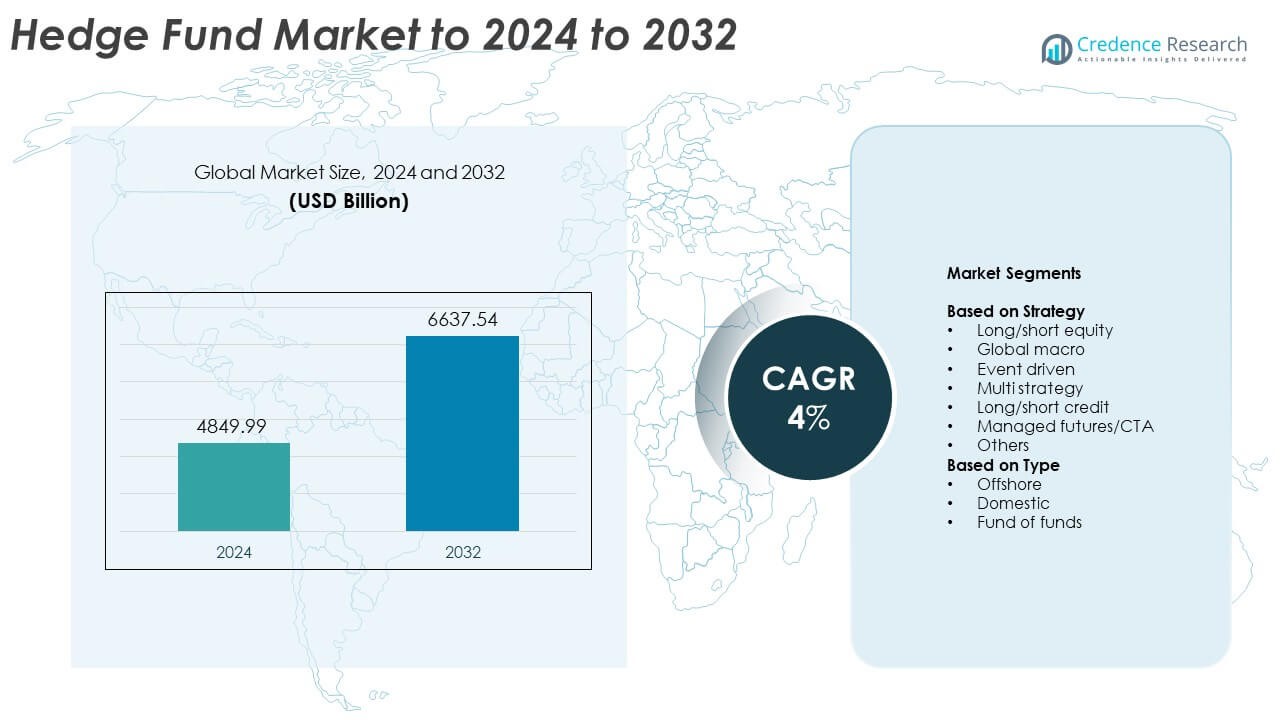
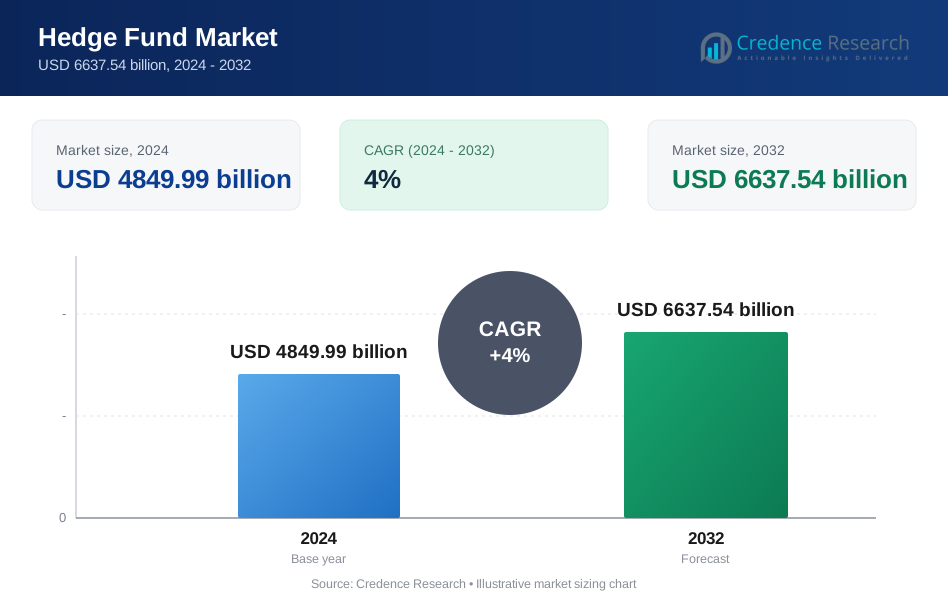
The Hedge Fund Market size was valued at USD 4849.99 billion in 2024 and is anticipated to reach USD 6637.54 billion by 2032, at a CAGR of 4% during the forecast period.
| REPORT ATTRIBUTE | DETAILS |
|---|---|
| Historical Period | 2020-2023 |
| Base Year | 2024 |
| Forecast Period | 2025-2032 |
| Hedge Fund Market Size 2024 | USD 4849.99 Billion |
| Hedge Fund Market, CAGR | 4% |
| Hedge Fund Market Size 2032 | USD 6637.54 Billion |
The hedge fund market is driven by prominent players such as Renaissance Technologies, Bridgewater Associates, Millennium Management, Citadel, Man Group, D.E. Shaw Group, TCI Fund Management, Two Sigma Investments/Advisers, Farallon Capital Management, Davidson Kempner Capital Management, and HFR (Hedge Fund Research). These firms dominate through advanced quantitative strategies, algorithmic trading, and diversified global portfolios. North America leads the market with a 45% share, supported by strong institutional participation and technological innovation. Europe follows with 28%, benefiting from regulated financial hubs and sustainable investment trends. Asia Pacific, holding 18%, is rapidly expanding through emerging market investments and growing investor participation.
Market Insights
- The hedge fund market was valued at USD 4849.99 billion in 2024 and is projected to reach USD 6637.54 billion by 2032, growing at a CAGR of 4% during the forecast period.
- Growth is driven by rising institutional investments, the adoption of AI-based trading systems, and a growing focus on risk-adjusted returns.
- Key market trends include the rise of ESG-integrated funds, digital trading platforms, and expansion in emerging economies.
- The market is highly competitive, led by major firms such as Renaissance Technologies, Bridgewater Associates, and Citadel, focusing on innovation and diversification.
- Regionally, North America holds a 45% share, followed by Europe at 28% and Asia Pacific at 18%, while the long/short equity strategy remains the leading segment with a 32% share.
Market Segmentation Analysis:
By Strategy
The long/short equity strategy dominated the hedge fund market in 2024, accounting for around 32% of the total market share. This strategy benefits from the flexibility to take both long and short positions, enabling investors to capture returns in bullish and bearish market conditions. Growing equity market volatility and rising institutional participation have strengthened demand. The use of AI-driven stock selection and advanced quantitative models improves portfolio performance and risk management. Investors continue to favor this strategy for its consistent alpha generation and diversified exposure across global equity markets.
- For instance, Marshall Wace’s TOPS sources ideas from over 1,000 outside contributors.
By Type
The offshore segment held the dominant position in the hedge fund market in 2024, representing approximately 61% of the total market share. This leadership is supported by favorable tax structures, investor confidentiality, and operational flexibility in jurisdictions such as the Cayman Islands and Luxembourg. Offshore funds attract institutional investors and high-net-worth individuals seeking global diversification and regulatory efficiency. These funds benefit from simplified compliance procedures and cross-border investment access. The offshore model remains a preferred choice among fund managers due to its scalability and international investor appeal.
- For instance, Millennium Management operated 330+ investment teams with 6,400+ employees globally, supporting complex offshore fund structures.
Key Growth Drivers
Rising Institutional Investments
Institutional investors, including pension funds and endowments, are increasingly allocating capital to hedge funds for portfolio diversification and higher risk-adjusted returns. These investors value hedge funds for their ability to manage volatility and preserve capital during market downturns. Expanding mandates and custom fund structures enable better alignment with institutional goals. This surge in institutional participation strengthens market stability and promotes large-scale fund development across global financial hubs.
- For instance, New Zealand Super Fund ran revamped multi-factor portfolios with 3 external managers, formalizing a larger role for specialist mandates.
Expansion of Quantitative and AI-Based Strategies
The growing adoption of artificial intelligence, machine learning, and data analytics is transforming hedge fund operations. Quant-driven strategies enhance trade execution, optimize asset allocation, and improve risk forecasting accuracy. Automated decision-making tools allow managers to process vast datasets in real time, improving performance consistency. These technological integrations attract tech-focused investors and provide competitive advantages in fast-changing capital markets.
- For instance, Two Sigma reported 380+ petabytes of data, 10,000+ data sources, and 250+ PhDs powering AI-driven research and trading.
Increased Demand for Portfolio Diversification
Investors are focusing on hedge funds as effective instruments for diversification amid global market uncertainties. Strategies combining equities, commodities, and derivatives help reduce exposure to single-asset risks. Multi-strategy and global macro funds deliver flexible allocations across regions and sectors, supporting stability in volatile conditions. This diversification demand continues to expand as investors seek consistent returns independent of traditional market cycles.
Key Trends & Opportunities
Integration of ESG and Sustainable Investing
Hedge funds are increasingly incorporating environmental, social, and governance principles into investment decisions. Sustainable hedge fund strategies attract institutional investors seeking responsible returns aligned with global sustainability standards. ESG integration not only enhances brand reputation but also mitigates long-term risk exposure. As global ESG reporting frameworks strengthen, hedge funds focusing on ethical investment approaches are expected to experience accelerated inflows.
- For instance, In 2024, M&G Investments' stewardship team voted at 10,214 company meetings-912 in the UK and 9,302 internationally-and opposed at least one management recommendation at 2,492 meetings
Expansion in Emerging Markets
Emerging economies present new opportunities for hedge fund expansion due to market liberalization and growing capital inflows. Regions in Asia-Pacific and Latin America are witnessing increased participation from global asset managers. Local partnerships, digital trading platforms, and flexible regulatory structures enable better market penetration. This shift toward emerging economies diversifies fund portfolios and drives higher return potential compared to mature markets.
- For instance, Point72's Singapore office has grown to more than 100 employees as of mid-2023.
Key Challenges
Regulatory Compliance and Oversight
Stringent global regulations pose operational challenges for hedge funds, particularly concerning transparency, reporting, and risk disclosure. Compliance with frameworks such as MiFID II and Dodd-Frank increases administrative costs and operational complexity. Managers face mounting pressure to adopt robust compliance technology and maintain investor confidence. Balancing regulatory adherence while preserving strategic flexibility remains a key challenge for fund operators.
Market Volatility and Liquidity Constraints
High market volatility and tightening liquidity conditions create performance pressures for hedge funds. Rapid changes in interest rates and currency fluctuations can disrupt leveraged positions. Funds employing high-frequency or arbitrage strategies face increased risks during liquidity crunches. Managing liquidity efficiently while maintaining return objectives requires stronger risk controls and adaptive investment frameworks to sustain long-term resilience.
Regional Analysis
North America
North America led the hedge fund market in 2024, accounting for around 45% of the total share. The region’s dominance is supported by the presence of major fund managers and high institutional participation. The United States drives most activity, fueled by sophisticated trading infrastructure, regulatory transparency, and innovation in quantitative and AI-driven strategies. Large pension funds and endowments continue to diversify allocations through hedge funds for stability and returns. Canada’s growing alternative investment ecosystem further supports market growth, with increasing cross-border fund collaborations and new product launches catering to high-net-worth and institutional investors.
Europe
Europe accounted for approximately 28% of the global hedge fund market share in 2024. The region benefits from strong financial centers such as the United Kingdom, Switzerland, and Luxembourg, which host numerous offshore funds and asset managers. Regulatory frameworks like AIFMD and MiFID II ensure transparency and investor protection. Sustainable investing and ESG integration have become key investment themes across European hedge funds. Institutional investors are increasingly allocating assets to multi-strategy and macro funds to navigate inflation and currency fluctuations. The region continues to attract global investors seeking regulatory stability and innovative fund structures.
Asia Pacific
Asia Pacific held a market share of about 18% in 2024, driven by rising investor interest in emerging economies such as China, Japan, Singapore, and Hong Kong. The region’s rapid economic growth and expanding wealth base encourage hedge fund investments focused on equities, currencies, and alternative assets. Governments are easing restrictions to attract global fund managers, while digital trading platforms improve operational efficiency. Japan and Australia host several established funds targeting long/short equity and macro strategies. Asia Pacific’s growing appetite for risk-adjusted returns positions it as a high-potential region for hedge fund expansion.
Latin America
Latin America captured nearly 5% of the global hedge fund market share in 2024. The region’s hedge fund landscape is expanding as investors seek protection against economic volatility and currency risks. Brazil, Mexico, and Chile dominate regional fund activity, supported by reforms that strengthen capital markets. Local managers are increasingly adopting global best practices in fund governance and risk control. The growing participation of private wealth investors and family offices supports fund diversification. As market sophistication improves, regional hedge funds are becoming important vehicles for managing liquidity and portfolio resilience.
Middle East & Africa
The Middle East and Africa region accounted for around 4% of the global hedge fund market share in 2024. Growth is driven by sovereign wealth funds and institutional investors seeking alternative investment exposure. Financial hubs such as Dubai and South Africa are emerging as regional centers for hedge fund management. Economic diversification initiatives, especially in the Gulf region, encourage new fund launches and partnerships with global asset managers. Increasing adoption of fintech solutions and favorable regulatory frameworks enhance transparency. The region’s rising investor sophistication supports gradual but steady hedge fund market expansion.
Market Segmentations:
By Strategy
- Long/short equity
- Global macro
- Event driven
- Multi strategy
- Long/short credit
- Managed futures/CTA
- Others
By Type
- Offshore
- Domestic
- Fund of funds
By Geography
- North America
- U.S.
- Canada
- Mexico
- Europe
- Germany
- France
- U.K.
- Italy
- Spain
- Rest of Europe
- Asia Pacific
- China
- Japan
- India
- South Korea
- South-east Asia
- Rest of Asia Pacific
- Latin America
- Brazil
- Argentina
- Rest of Latin America
- Middle East & Africa
- GCC Countries
- South Africa
- Rest of the Middle East and Africa
Competitive Landscape
The hedge fund market is highly competitive, with leading players such as Renaissance Technologies, Bridgewater Associates, Millennium Management, Citadel, Man Group, D.E. Shaw Group, TCI Fund Management, Two Sigma Investments/Advisers, Farallon Capital Management, Davidson Kempner Capital Management, and HFR (Hedge Fund Research) shaping the global landscape. These firms compete through innovation in quantitative modeling, risk-adjusted performance, and advanced algorithmic trading. Many hedge funds are investing heavily in artificial intelligence, big data analytics, and cloud-based infrastructure to enhance decision-making and trading precision. The growing demand for ESG-aligned funds and multi-strategy approaches is pushing managers to diversify portfolios and adopt flexible investment structures. Strategic collaborations, technological upgrades, and global market expansion remain key focus areas. Additionally, firms are optimizing operations to comply with evolving regulations while maintaining transparency and investor confidence. Continuous innovation and adaptive strategies are essential for sustaining competitive advantage in this dynamic investment environment.
Key Player Analysis
- Renaissance Technologies
- Bridgewater Associates
- Millennium Management
- Citadel
- Man Group
- E. Shaw Group
- TCI Fund Management
- Two Sigma Investments/Advisers
- Farallon Capital Management
- Davidson Kempner Capital Management
- HFR (Hedge Fund Research)
Recent Developments
- In 2025, Citadel acquired the German power trading firm FlexPower, a move designed to expand its energy trading and market-making capabilities. The firm also announced the opening of a new office in Boston's South Station Tower
- In 2024, Bridgewater reorganized its structure into two main units: "Alpha Engine," which runs the flagship Pure Alpha fund, and "Total Portfolio Strategies," which manages the All Weather and Defensive Alpha funds.
- In 2024, HFR (Hedge Fund Research) and Radient AI formed a strategic partnership aimed at enhancing hedge fund analysis through the integration of advanced artificial intelligence capabilities.
Report Coverage
The research report offers an in-depth analysis based on Strategy, Type and Geography. It details leading market players, providing an overview of their business, product offerings, investments, revenue streams, and key applications. Additionally, the report includes insights into the competitive environment, SWOT analysis, current market trends, as well as the primary drivers and constraints. Furthermore, it discusses various factors that have driven market expansion in recent years. The report also explores market dynamics, regulatory scenarios, and technological advancements that are shaping the industry. It assesses the impact of external factors and global economic changes on market growth. Lastly, it provides strategic recommendations for new entrants and established companies to navigate the complexities of the market.
Future Outlook
- Hedge funds will increasingly adopt AI and machine learning for predictive investment strategies.
- Institutional investors will expand allocations to hedge funds for portfolio diversification and stability.
- ESG-focused hedge fund strategies will gain stronger traction among global investors.
- Multi-strategy and hybrid fund structures will become more popular for risk management.
- Emerging markets in Asia and Latin America will attract higher hedge fund inflows.
- Regulatory technology solutions will streamline compliance and reporting processes.
- Digital platforms will enhance investor transparency and real-time portfolio access.
- Data-driven decision-making will improve risk forecasting and performance optimization.
- Hedge funds will explore tokenized and blockchain-based investment products.
- Collaborations between hedge funds and fintech firms will drive operational efficiency and innovation.
Request a Free Sample
Fill in your details and we'll send you a free sample report.
- Sample data tables & charts
- Research methodology
Need a Custom Version of This Report?
Tailor the scope, geography, or segments to your exact requirements.
- Custom geography or segment scope
- Direct access to our analyst team
Frequently Asked Questions
What is the current market size for the Hedge Fund Market, and what is its projected size in 2032?
At what Compound Annual Growth Rate is the Hedge Fund Market projected to grow between 2025 and 2032?
Which Hedge Fund Market segment held the largest share in 2024?
What are the primary factors fueling the growth of the Hedge Fund Market?
Who are the leading companies in the Hedge Fund Market?
Which region commanded the largest share of the Hedge Fund Market in 2024?
Table of Content
Chapter 1 Market Segmentation
- 1.1 Segmentation Framework
- 1.1.1 Product and Service Classification
- 1.1.2 Application and End-Use Classification
- 1.1.3 Technology and Solution Classification
- 1.1.4 Customer and Distribution Channel Classification
- 1.1.5 Geographic Segmentation
- 1.1.6 Market Segment Definitions and Boundaries
Chapter 2 Introduction
- 2.1 Report Objectives and Scope
- 2.2 Product Definition and Industry Terminology
- 2.3 Market Inclusions and Exclusions
- 2.4 Research Process
- 2.4.1 Primary Research and Expert Interviews
- 2.4.2 Secondary Research and Source Review
- 2.4.3 Top-Down and Bottom-Up Estimation
- 2.4.4 Data Triangulation and Verification
- 2.5 Market Size Measurement Basis
- 2.5.1 2024: USD 4849.99 billion → 2032: USD 6637.54 billion
- 2.6 Historical and Forecast Reference Periods
- 2.6.1 Base Year: 2024
- 2.6.2 Forecast Period: 2024-2032
- 2.7 Research Assumptions and Limitations
Chapter 3 Executive Summary
- 3.1 Market Snapshot and Key Findings
- 3.2 Base-Year Market Size, 2024
- 3.3 Forecast Market Size, 2032
- 3.4 Revenue and Volume Growth Outlook
- 3.5 Key Demand and Supply Indicators
- 3.6 Leading Market Segments
- 3.7 Fastest-Growing Market Opportunities
- 3.8 Regional Performance Highlights
- 3.9 Technology and Industry Transformation
- 3.10 Competitive Landscape Summary
- 3.11 Analyst View and Strategic Implications
Chapter 4 Global Hedge Fund Market Trends and Developments
- 4.1 Historical Industry Development
- 4.2 Recent Market Trends and Developments
- 4.3 Demand and Customer Behavior Trends
- 4.4 Technology and Product Innovation
- 4.5 Artificial Intelligence, Automation and Digitalization
- 4.6 Local Manufacturing and Supply Chain Realignment
- 4.7 Industry Partnerships, Mergers and Acquisitions
- 4.8 Sustainability and Circular Economy Developments
- 4.9 Government and Private Sector Investment Trends
- 4.10 Emerging Business Models and Commercialization
- 4.11 Industry Developments and Announcements
Chapter 5 Global Hedge Fund Market Supply and Demand Analysis
- 5.1 Demand Trend and Consumption Analysis
- 5.2 Demand Forecast, 2024-2032
- 5.3 Supply Chain Structure and Procurement Trends
- 5.4 Supply-Demand Gap and Bottlenecks
- 5.5 Import Dependence and Sourcing Structure
- 5.6 Regional Supply and Demand Concentration
Chapter 6 Global Hedge Fund Market Pricing Analysis
- 6.1 Pricing Structure and Measurement
- 6.2 Historical Pricing Trends
- 6.3 Pricing Outlook, 2024-2032
- 6.4 Pricing by Product and Market Segment
- 6.5 Geographic Pricing Differences
- 6.6 Key Input, Energy, Labor and Logistics Costs
- 6.7 Contract Pricing and Purchasing Models
- 6.8 Pricing Sensitivity and Competitive Positioning
- 6.9 Price, Margin and Profitability Implications
Chapter 7 Global Hedge Fund Market Dynamics
- 7.1 Market Growth Drivers
- 7.1.1 Demand-Side Drivers
- 7.1.2 Technology and Innovation Drivers
- 7.1.3 Infrastructure and Investment Drivers
- 7.1.4 Regulatory and Policy Drivers
- 7.2 Market Restraints
- 7.2.1 Cost and Affordability Constraints
- 7.2.2 Technology and Adoption Barriers
- 7.2.3 Supply Chain and Operational Constraints
- 7.3 Market Challenges
- 7.3.1 Competitive Pressure and Margin Erosion
- 7.3.2 Skills, Infrastructure and Implementation Gaps
- 7.4 Emerging Market Opportunities
- 7.5 Market Dynamics Impact and Time-Horizon Assessment
Chapter 8 Global Hedge Fund Value Chain Analysis
- 8.1 Industry Value Chain Overview
- 8.2 Upstream Suppliers and Critical Inputs
- 8.3 Technology and Component Providers
- 8.4 Manufacturing or Service Delivery
- 8.5 Distribution, Channel Partners and Integrators
- 8.6 Downstream Applications and End Users
- 8.7 Value Addition and Profit Pools
- 8.8 Vertical Integration and Outsourcing
- 8.9 Supplier Concentration and Risk
- 8.10 Supply Chain Localization and Resilience
Chapter 9 Global Hedge Fund Market Regulations and Policies
- 9.1 Relevant Laws, Standards and Compliance Frameworks
- 9.2 Product, Service, Safety and Quality Requirements
- 9.3 Government Policies, Incentives and Subsidies
- 9.4 Imports, Exports and Trade Barriers
- 9.5 Public Procurement and Local Content Requirements
- 9.6 Data Protection, AI and Cybersecurity Compliance
- 9.7 Upcoming Policy Changes and Market Implications
Chapter 10 Global Hedge Fund Market Hotspots and Opportunities
- 10.1 Market Opportunity Mapping and Growth Hotspots
- 10.2 High-Growth Applications and Customer Groups
- 10.3 Underserved Markets and White-Space Opportunities
- 10.4 Emerging Technology and Product Opportunities
- 10.5 New Capacity and Investment Hotspots
- 10.6 Market Entry and Expansion Opportunities
- 10.7 Distribution and Partnership Opportunities
- 10.8 Near-Term and Long-Term Commercial Potential
- 10.9 Opportunity Attractiveness and Execution Risks
Chapter 11 Global Hedge Fund Market Outlook, 2024-2032
- 11.1 Market Size and Analysis
- 11.1.1 Revenue (Market Measurement: 2024: USD 4849.99 billion → 2032: USD 6637.54 billion)
- 11.1.2 Historical Market Size
- 11.1.3 Base-Year Market Size, 2024
- 11.2 Market Forecast, 2024-2032
- 11.2.1 Revenue Forecast to 2032
- 11.2.2 CAGR and Year-on-Year Growth
- 11.2.3 Incremental Revenue Opportunity
- 11.3 Forecast Assumptions and Scenario Analysis
- 11.3.1 Base-Case Forecast
- 11.3.2 Optimistic and Conservative Scenarios
- 11.3.3 Technology, Pricing and Policy Sensitivities
- 11.4 Market Attractiveness and Growth Outlook
Chapter 12 Global Hedge Fund Market Segmentation and Outlook
- 12.1 Segmentation Summary and Market Shares, 2024
- 12.2 Largest and Fastest-Growing Segments
- 12.3 Segment Growth Comparison
- 12.4 Segment Attractiveness and Priority Matrix
Chapter 13 Global Hedge Fund Geographic Market Outlook, 2024-2032
- 13.1 Regional Market Size and Share, 2024
- 13.2 Regional Market Forecast, 2024-2032
- 13.3 Regional Pricing, Production and Demand Differences
- 13.4 North America
- 13.4.1 United States
- 13.4.2 Canada
- 13.4.3 Mexico
- 13.5 Europe
- 13.5.1 Germany
- 13.5.2 France
- 13.5.3 Italy
- 13.5.4 United Kingdom
- 13.5.5 Spain
- 13.5.6 Poland
- 13.5.7 Russia
- 13.5.8 Netherlands
- 13.5.9 Belgium
- 13.5.10 Sweden
- 13.5.11 Denmark
- 13.5.12 Norway
- 13.5.13 Rest of Europe
- 13.6 Asia Pacific
- 13.6.1 China
- 13.6.2 India
- 13.6.3 Japan
- 13.6.4 South Korea
- 13.6.5 Thailand
- 13.6.6 Indonesia
- 13.6.7 Vietnam
- 13.6.8 Malaysia
- 13.6.9 Australia
- 13.6.10 Rest of Asia Pacific
- 13.7 Latin America
- 13.7.1 Brazil
- 13.7.2 Argentina
- 13.7.3 Colombia
- 13.7.4 Chile
- 13.7.5 Rest of Latin America
- 13.8 Middle East
- 13.8.1 Saudi Arabia
- 13.8.2 United Arab Emirates
- 13.8.3 Turkey
- 13.8.4 Israel
- 13.8.5 Iran
- 13.8.6 Rest of the Middle East
- 13.9 Africa
- 13.9.1 South Africa
- 13.9.2 Egypt
- 13.9.3 Nigeria
- 13.9.4 Morocco
- 13.9.5 Rest of Africa
- 13.10 Regional Investment, Policy and Supply Chain Differences
- 13.11 Regional Competitive Landscape
- 13.12 Geographic Growth Hotspots
Chapter 14 Global Hedge Fund Technology, Innovation and Sustainability Outlook
- 14.1 Technology Landscape and Maturity
- 14.2 Product, Process and Service Innovation
- 14.3 AI, Automation and Digital Tools in the Industry
- 14.4 Technology Adoption and Performance Benchmarking
- 14.5 Innovation Pipeline and R&D Investment
- 14.6 Energy Efficiency and Resource Management
- 14.7 Sustainability, Recycling and Circularity
- 14.8 Technology Roadmap, 2024-2032
- 14.9 Risks of Obsolescence and Technology Substitution
Chapter 15 Global Hedge Fund Market Key Strategic Imperatives
- 15.1 Growth and Market Entry Priorities
- 15.2 High-Return Products and Segments
- 15.3 Pricing, Profitability and Cost Optimization
- 15.4 Technology Investment and Product Differentiation
- 15.5 Supply Chain Localization and Resilience
- 15.6 Distribution and Customer Acquisition
- 15.7 Partnership, Acquisition and Capacity Strategy
- 15.8 Regional Expansion Priorities
- 15.9 Short-, Medium- and Long-Term Actions
Chapter 16 Competition Outlook
- 16.1 Industry Competition Characteristics
- 16.2 Market Structure and Concentration
- 16.3 Market Share and Competitive Positioning, 2024
- 16.4 Company-Wise Revenue and Product Benchmarking
- 16.5 Production and Service Capacity Benchmarking
- 16.6 Technology, Pricing and Differentiation
- 16.7 Regional Footprint and Distribution Strength
- 16.8 Mergers, Acquisitions and Strategic Alliances
- 16.9 New Entrants and Competitive Threats
- 16.10 Porter's Five Forces and Industry Attractiveness
- 16.11 Competitive Outlook, 2024-2032
Chapter 17 Company Profiles
- 17.1 Company Coverage and Selection Criteria
- 17.2 Leading Market Participants – Standard Profile Structure
- 17.2.1 Business Description
- 17.2.2 Company Ownership and Geographic Presence
- 17.2.3 Product and Service Portfolio
- 17.2.4 Manufacturing and Operating Footprint
- 17.2.5 Financial Performance and Investment
- 17.2.6 Market Share and Competitive Position
- 17.2.7 Technology and Innovation Capabilities
- 17.2.8 Strategic Alliances or Partnerships
- 17.2.9 Recent Developments
- 17.2.10 Growth Strategy and Outlook
- 17.3 Other Relevant Market Participants
Note: Every listed company is profiled on the structure shown under the first company. The company list is preliminary and may change based on research findings, market developments, data availability and client requirements.
Chapter 18 Disclaimer
- 18.1 Research and Forecast Disclaimer
- 18.2 Data Source and Estimation Limitations
Note: The depth of individual sections depends on data availability for this market. Volume, capacity, trade and other unit-based metrics are included where applicable.

