Market Overview
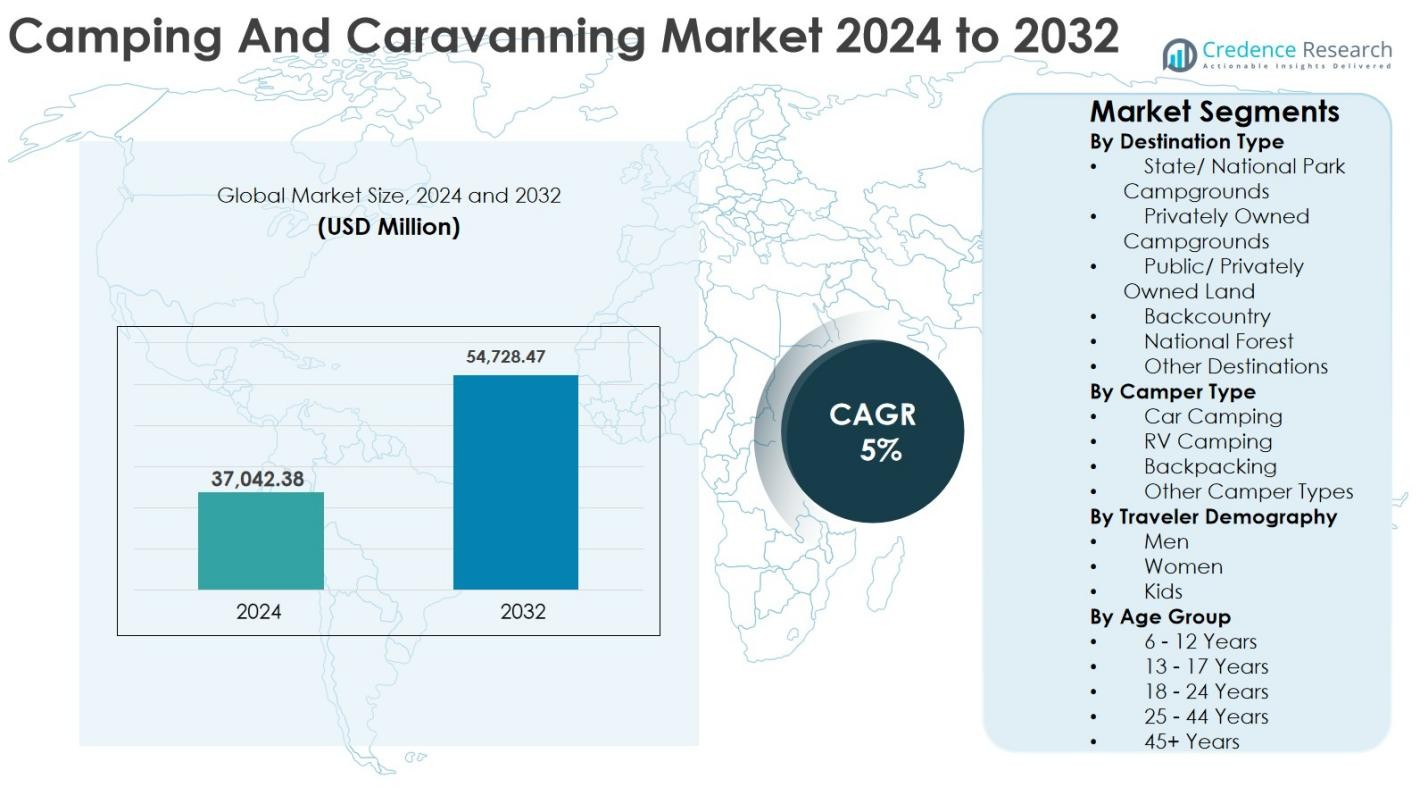
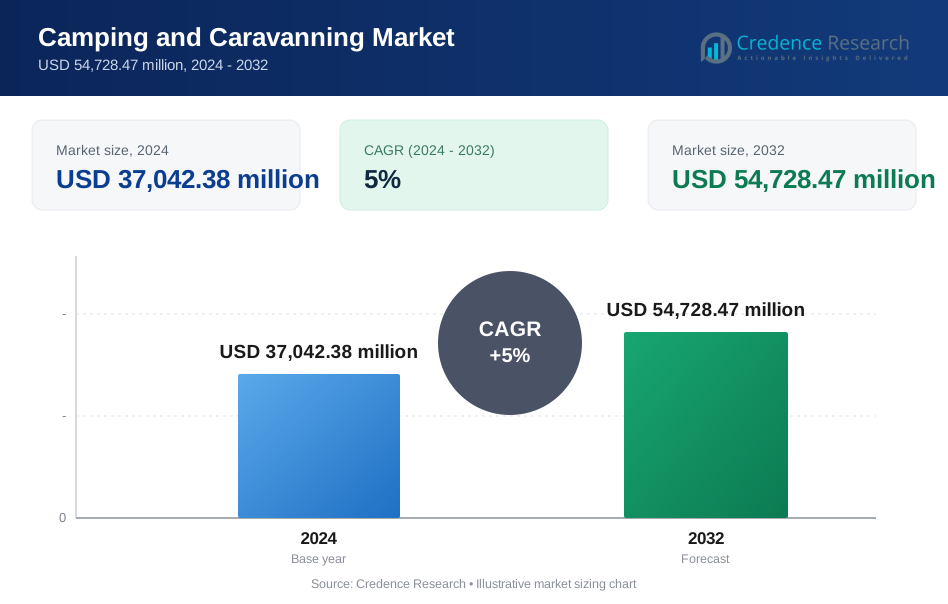
The Camping and Caravanning Market size was valued at USD 37,042.38 million in 2024 and is anticipated to reach USD 54,728.47 million by 2032, expanding at a CAGR of 5% during the forecast period.
| REPORT ATTRIBUTE | DETAILS |
|---|---|
| Historical Period | 2020-2023 |
| Base Year | 2024 |
| Forecast Period | 2025-2032 |
| Camping and Caravanning Market Size 2024 | USD 37,042.38 Million |
| Camping and Caravanning Market, CAGR | 5% |
| Camping and Caravanning Market Size 2032 | USD 54,728.47 Million |
The Camping and Caravanning market is shaped by a mix of established campground operators and digital travel platforms that focus on accessibility, experience enhancement, and flexible booking models. Key players such as RVshare, Kampgrounds of America (KOA), Hipcamp, Inc., Glamping Hub, Camplify, Yescapa, and Harvest Hosts strengthen their presence through platform expansion, premium camping offerings, and peer-to-peer rental services. These companies emphasize technology integration, destination diversification, and customer-centric services to capture rising outdoor tourism demand. Regionally, North America led the Camping and Caravanning market with an exact market share of 42% in 2024, driven by high RV ownership, extensive national and state park infrastructure, and strong domestic travel trends, followed by Europe as the second-largest regional contributor.
Market Insights
- The Camping and Caravanning market was valued at USD 37,042.38 million in 2024 and is projected to reach USD 54,728.47 million by 2032, growing at a CAGR of 5% driven by rising outdoor recreation and domestic tourism demand.
- Growing preference for nature-based travel, cost-effective vacations, and flexible mobility continues to drive market expansion, supported by increasing RV ownership, rental platforms, and improved campground infrastructure across developed and emerging economies.
- RV camping held the largest segment share of about 41% in 2024, while glamping and premium camping formats are gaining traction due to rising demand for comfort-oriented outdoor experiences and higher per-trip spending.
- The market remains moderately fragmented, with players such as RVshare, KOA, Hipcamp, Glamping Hub, Camplify, and Yescapa focusing on digital platforms, campground expansion, and differentiated service offerings.
- North America led with 42% market share, followed by Europe at 30%, Asia Pacific at 17%, Latin America at 6%, and Middle East & Africa at 5%, reflecting varied infrastructure maturity and tourism patterns.
 Market Segmentation Analysis:
By Destination Type
The Camping and Caravanning market, by destination type, is led by State/National Park Campgrounds, which accounted for around 34% market share in 2024. This dominance is driven by well-developed infrastructure, scenic locations, safety standards, and affordability compared to private resorts. Increasing government investment in park facilities, improved campground amenities, and rising domestic tourism continue to strengthen this segment. Privately Owned Campgrounds follow closely, supported by premium services and family-oriented offerings. Growing interest in National Forest and Backcountry camping is further fueled by adventure tourism and demand for nature-immersive travel experiences.
- For instance, the U.S. National Park Service reported over 13 million overnight stays in campgrounds and backcountry sites in 2023 across parks such as Yellowstone and Yosemite, supported by maintained roads, ranger services, and organized campsites.
By Camper Type
By camper type, RV Camping emerged as the dominant sub-segment, holding 41% of the Camping and Caravanning market share in 2024. The segment benefits from rising RV ownership, comfort-driven travel preferences, and increasing availability of RV-friendly campgrounds. Technological advancements in RVs, including smart features and energy-efficient systems, further support growth. Car Camping remains a strong contributor due to low entry costs and flexibility, while Backpacking gains traction among younger travelers seeking adventure and sustainability. Expanding rental platforms and peer-to-peer RV sharing models continue to accelerate market participation.
- For instance, Hipcamp and Outdoorsy have expanded access to car‑accessible sites and RV rentals, enabling first‑time campers to participate without owning gear or vehicles.
By Traveler Demography
Based on traveler demography, Adults (Men and Women combined) dominated the Camping and Caravanning market with 68% share in 2024, driven by higher spending capacity and growing preference for experiential travel. Men accounted for the larger individual share, supported by adventure tourism and solo travel trends, while Women participation continues to rise due to safety-focused camp services and group travel options. The Kids segment is expanding steadily, fueled by family camping trips, educational outdoor activities, and increased promotion of nature-based recreation among households.
Key Growth Drivers
Rising Demand for Domestic and Nature-Based Tourism
The Camping and Caravanning market is strongly driven by the rising preference for domestic and nature-based tourism. Travelers increasingly seek outdoor recreational experiences that offer relaxation, adventure, and closer engagement with nature, particularly in the post-pandemic travel landscape. Camping provides cost-effective alternatives to hotels while enabling flexible travel plans, making it attractive to families, solo travelers, and adventure enthusiasts. Government initiatives promoting national parks, eco-tourism destinations, and rural tourism infrastructure further support market growth. Improved campground facilities, digital booking platforms, and accessibility enhancements encourage repeat visits. This shift toward experiential travel continues to expand participation across diverse demographics, strengthening long-term demand for camping and caravanning services.
- For instance, the Kampgrounds of America (KOA) 2024 North American Camping and Outdoor Hospitality Report notes that over half of campers say they are camping more than they did three years ago, with many prioritizing time in nature and stress relief.
Growth in RV Ownership and Rental Platforms
The increasing ownership of recreational vehicles and expansion of RV rental platforms significantly accelerate the Camping and Caravanning market. Consumers value RV travel for its comfort, privacy, and mobility, enabling long-distance trips without dependence on traditional accommodations. Peer-to-peer rental platforms and short-term leasing models reduce ownership barriers, attracting first-time users and younger travelers. Technological advancements in RV design, including fuel efficiency, compact layouts, and smart onboard systems, further enhance adoption. Additionally, expanding RV-friendly infrastructure such as service stations and designated parking areas supports broader usage, positioning RV camping as a mainstream travel option.
- For instance, Outdoorsy has reported millions of booked rental days globally, while RVshare notes strong uptake among Millennials and Gen Z using peer‑to‑peer rentals for road trips and remote work travel.
Increasing Participation from Families and Younger Travelers
Growing participation from families and younger travelers acts as a key driver in the Camping and Caravanning market. Families increasingly choose camping for educational and bonding experiences, while younger consumers are drawn to adventure, sustainability, and social experiences. Social media exposure, influencer-led travel content, and outdoor lifestyle branding positively shape consumer perceptions. Affordable entry options such as car camping, glamping, and short-duration trips broaden market reach. Educational outdoor programs, youth camping initiatives, and wellness-focused retreats further reinforce engagement, supporting consistent growth across age groups and income levels.
Key Trends & Opportunities
Expansion of Glamping and Premium Camping Experiences
The rapid expansion of glamping and premium camping represents a major trend and opportunity in the Camping and Caravanning market. Consumers increasingly seek comfort-driven outdoor experiences that combine nature with hotel-like amenities. Luxury tents, eco-lodges, and fully serviced caravans attract high-spending travelers and first-time campers. This trend creates opportunities for private operators to differentiate through design, sustainability, and personalized services. Integration of wellness offerings, curated experiences, and technology-enabled conveniences enhances customer satisfaction. As demand for upscale outdoor stays rises, glamping is expected to contribute significantly to market value growth.
- For instance, Under Canvas in the U.S. reports strong occupancy at its safari‑style tent resorts near national parks such as Yellowstone and Zion, offering king beds, ensuite bathrooms, and on‑site dining.
Digitalization and Online Booking Platforms
Digitalization is transforming the Camping and Caravanning market by improving accessibility, planning, and user experience. Online platforms enable real-time campground availability, dynamic pricing, and personalized recommendations. Mobile apps offering navigation, campsite reviews, and activity planning increase consumer confidence and convenience. Data-driven insights allow operators to optimize occupancy and target specific traveler segments. The integration of digital payments, contactless check-ins, and subscription-based camping services further enhances operational efficiency. Continued investment in digital ecosystems presents long-term growth opportunities for both public and private campsite operators.
- For instance, Kampgrounds of America (KOA) uses its KOA app and rewards program to support mobile booking, cashless payment, and guest profiling across its network of campgrounds.
Key Challenges
Seasonality and Weather Dependency
Seasonality and weather dependency remain significant challenges for the Camping and Caravanning market. Demand is highly concentrated during favorable weather conditions, leading to fluctuating revenue streams and underutilized assets during off-peak seasons. Extreme weather events, including heatwaves, storms, and wildfires, disrupt travel plans and reduce campsite occupancy. Operators face difficulties maintaining consistent staffing levels and managing fixed operational costs year-round. Limited seasonal predictability also affects consumer booking behavior. Addressing this challenge requires diversification of offerings, off-season promotions, and investment in all-weather infrastructure.
Environmental Regulations and Infrastructure Constraints
Environmental regulations and infrastructure limitations pose another critical challenge in the Camping and Caravanning market. Stricter land-use policies, conservation requirements, and waste management regulations increase compliance costs for operators. Overcrowding in popular destinations strains natural resources and campground facilities, leading to capacity constraints. Inadequate infrastructure in remote areas, including roads, utilities, and connectivity, restricts expansion potential. Balancing environmental sustainability with commercial growth remains complex. Operators must invest in eco-friendly practices and collaborate with authorities to ensure long-term market viability.
Regional Analysis
North America
North America dominated the Camping and Caravanning market with 42% market share in 2024, supported by a strong outdoor recreation culture, high RV ownership, and extensive campground infrastructure. The United States leads regional growth due to well-established national and state parks, advanced booking platforms, and widespread availability of RV-friendly facilities. Rising participation in road trips, family camping, and adventure tourism continues to drive demand. Canada also contributes steadily, supported by nature-based tourism and government investment in park maintenance. Strong disposable income levels and premium camping trends further reinforce regional market leadership.
Europe
Europe accounted for 30% of the Camping and Caravanning market share in 2024, driven by a mature caravanning culture and strong cross-border tourism. Countries such as France, Germany, the UK, and Italy remain key contributors due to well-developed campsite networks and high adoption of motorhomes and caravans. Growing preference for eco-tourism, sustainable travel, and countryside vacations supports regional growth. Government support for tourism infrastructure and increasing popularity of glamping experiences enhance market expansion. Seasonal travel patterns and strong domestic tourism further sustain demand across Western and Northern Europe.
Asia Pacific
Asia Pacific held 17% market share in 2024 and represents the fastest-growing region in the Camping and Caravanning market. Rising disposable incomes, expanding middle-class populations, and increasing interest in outdoor leisure activities drive growth across China, Australia, Japan, and South Korea. Australia remains a major contributor due to strong RV tourism and vast camping destinations. Improving tourism infrastructure, digital campground platforms, and growing youth participation further accelerate adoption. Government initiatives promoting domestic tourism and nature-based travel experiences support long-term regional expansion.
Latin America
Latin America captured 6% of the Camping and Caravanning market share in 2024, supported by growing adventure tourism and nature-focused travel. Countries such as Brazil, Chile, and Argentina benefit from diverse landscapes and increasing interest in outdoor recreation. While infrastructure remains less developed than in mature markets, rising domestic tourism and affordable camping options drive steady growth. Expansion of private campgrounds and increased promotion of eco-tourism destinations enhance regional appeal. Improving road connectivity and growing awareness of camping as a leisure activity continue to support gradual market development.
Middle East & Africa
The Middle East & Africa region accounted for about 5% of the Camping and Caravanning market share in 2024, driven by niche tourism segments and unique outdoor experiences. Desert camping, safari tourism, and luxury glamping drive demand in the Middle East, particularly in the UAE and Saudi Arabia. In Africa, nature reserves and wildlife tourism support selective growth. Infrastructure limitations and climatic conditions restrict large-scale adoption; however, government-backed tourism diversification strategies and investments in premium outdoor accommodations continue to create growth opportunities across the region.
Market Segmentations
By Destination Type
- State/ National Park Campgrounds
- Privately Owned Campgrounds
- Public/ Privately Owned Land
- Backcountry
- National Forest
- Other Destinations
By Camper Type
- Car Camping
- RV Camping
- Backpacking
- Other Camper Types
By Traveler Demography
- Men
- Women
- Kids
By Age Group
- 6 - 12 Years
- 13 - 17 Years
- 18 - 24 Years
- 25 - 44 Years
- 45+ Years
By Geography
- North America
- U.S.
- Canada
- Mexico
- Europe
- Germany
- France
- U.K.
- Italy
- Spain
- Rest of Europe
- Asia Pacific
- China
- Japan
- India
- South Korea
- South-east Asia
- Rest of Asia Pacific
- Latin America
- Brazil
- Argentina
- Rest of Latin America
- Middle East & Africa
- GCC Countries
- South Africa
- Rest of the Middle East and Africa
Competitive Landscape
The Camping and Caravanning market features a dynamic competitive landscape characterized by the presence of digital platforms, campground operators, and experience-focused travel providers. Key players such as RVshare, Kampgrounds of America (KOA), Hipcamp, Inc., Glamping Hub, Camplify, Yescapa, and Harvest Hosts focus on expanding campsite access, improving user experience, and leveraging technology-driven booking models. Platform-based companies emphasize peer-to-peer rentals, diversified destination listings, and flexible pricing to attract a broad consumer base. Established operators like KOA and Suncamp Holidays invest in campground expansion, premium amenities, and loyalty programs to strengthen brand presence. Players such as Trek Travel and Recreation.gov benefit from curated experiences and government-backed infrastructure access. Strategic partnerships, geographic expansion, and service differentiation through glamping, RV rentals, and digital integration remain central to sustaining market position and capturing evolving consumer demand.
Key Player Analysis
- Hipcamp, Inc.
- Suncamp Holidays
- RVshare
- Trek Travel
- Yescapa
- Recreation.gov
- Camplify
- Harvest Hosts
- Glamping Hub
- Kampgrounds of America (KOA)
Recent Developments
- In December 2025, Octane Lending Inc. partnered with Camping World Holdings, Inc. to launch a new financing solution under the Good Sam Powered by Octane brand, enabling flexible RV financing options for customers through Camping World’s dealer network
- In November 2025, First Camp Group AB entered into an agreement to acquire nine camping destinations in Germany and Switzerland from lodgyslife AG, strengthening its footprint in key European markets
- In November 2025, lodgyslife AG entered into a strategic partnership with First Camp Group to bundle its operational camping business with First Camp for growth across Germany and Switzerland, with additional acquisitions planned.
Report Coverage
The research report offers an in-depth analysis based on Destination Type, Camper Type, Traveler Demography Age Group and Geography. It details leading market players, providing an overview of their business, product offerings, investments, revenue streams, and key applications. Additionally, the report includes insights into the competitive environment, SWOT analysis, current market trends, as well as the primary drivers and constraints. Furthermore, it discusses various factors that have driven market expansion in recent years. The report also explores market dynamics, regulatory scenarios, and technological advancements that are shaping the industry. It assesses the impact of external factors and global economic changes on market growth. Lastly, it provides strategic recommendations for new entrants and established companies to navigate the complexities of the market.
Future Outlook
- The Camping and Caravanning market will witness steady growth driven by sustained interest in outdoor and experiential travel.
- RV camping will continue to expand as rental platforms lower entry barriers for first-time users.
- Glamping and premium camping formats will gain wider acceptance among comfort-focused travelers.
- Digital booking platforms and mobile applications will enhance trip planning and campsite accessibility.
- Family and group camping will remain a core demand segment supported by recreational and educational activities.
- Younger travelers will increasingly influence market growth through adventure-oriented and sustainable travel preferences.
- Investment in campground infrastructure and modern amenities will improve overall service quality.
- Eco-friendly practices and low-impact camping solutions will shape operator strategies.
- Emerging markets will see higher participation due to rising disposable incomes and domestic tourism promotion.
- Strategic partnerships and service diversification will strengthen long-term market competitiveness.
Request a Free Sample
Fill in your details and we'll send you a free sample report.
- Sample data tables & charts
- Research methodology
Market Dynamics
Growth in RV Ownership and Rental Platforms
The increasing popularity of recreational vehicles, coupled with the rise of peer-to-peer rental platforms, is making RV camping more accessible and attractive to a wider demographic. This trend is lowering entry barriers for first-time campers and supporting the expansion of RV-friendly infrastructure.
Expansion of Glamping and Premium Camping Experiences
Demand for comfort-oriented outdoor stays is driving the growth of glamping and premium camping formats, attracting high-spending travelers and first-time campers seeking hotel-like amenities in natural settings. This trend is boosting average per-trip spending and encouraging private operators to invest in upscale offerings.
Digitalization and Online Booking Platforms
The adoption of digital booking platforms and mobile applications is streamlining trip planning, improving campsite accessibility, and enhancing the overall user experience. Real-time availability, dynamic pricing, and personalized recommendations are increasing consumer confidence and operational efficiency for campground operators.
Rising Participation from Families and Younger Travelers
Families and younger consumers are increasingly choosing camping for educational, bonding, and adventure experiences. Social media influence, affordable entry options, and youth-focused programs are broadening the market's appeal and driving consistent growth across age groups.
Government Support and Investment in Outdoor Infrastructure
Government initiatives promoting national parks, eco-tourism, and rural tourism infrastructure are improving campground facilities and accessibility. These investments are encouraging repeat visits and supporting the long-term expansion of the camping and caravanning market.
Need a Custom Version of This Report?
Tailor the scope, geography, or segments to your exact requirements.
- Custom geography or segment scope
- Direct access to our analyst team
Frequently Asked Questions
What is the current market size for the Camping And Caravanning market, and what is its projected size in 2032?
At what Compound Annual Growth Rate is the Camping And Caravanning market projected to grow between 2024 and 2032?
Which Camping And Caravanning market segment held the largest share in 2024?
What are the primary factors fueling the growth of the Camping And Caravanning market?
Who are the leading companies in the Camping And Caravanning market?
Which region commanded the largest share of the Camping And Caravanning market in 2024?
Table of Content
Chapter 1 Market Segmentation
- 1.1 Segmentation Framework
- 1.1.1 Product and Service Classification
- 1.1.2 Application and End-Use Classification
- 1.1.3 Technology and Solution Classification
- 1.1.4 Customer and Distribution Channel Classification
- 1.1.5 Geographic Segmentation
- 1.1.6 Market Segment Definitions and Boundaries
- 1.2 By Age Group
- 1.2.1 6 - 12 Years
- 1.2.2 13 - 17 Years
- 1.2.3 18 - 24 Years
- 1.2.4 25 - 44 Years
- 1.2.5 45+ Years
- 1.3 By Camper Type
- 1.3.1 Car Camping
- 1.3.2 RV Camping
- 1.3.3 Backpacking
- 1.3.4 Other Camper Types
- 1.4 By Destination Type
- 1.4.1 State/National Park Campgrounds
- 1.4.2 Privately Owned Campgrounds
- 1.4.3 Public/Privately Owned Land
- 1.4.4 Backcountry
- 1.4.5 National Forest
- 1.4.6 Other Destinations
- 1.5 By Traveler Demography
- 1.5.1 Men
- 1.5.2 Women
- 1.5.3 Kids
Chapter 2 Introduction
- 2.1 Report Objectives and Scope
- 2.2 Product Definition and Industry Terminology
- 2.3 Market Inclusions and Exclusions
- 2.4 Research Process
- 2.4.1 Primary Research and Expert Interviews
- 2.4.2 Secondary Research and Source Review
- 2.4.3 Top-Down and Bottom-Up Estimation
- 2.4.4 Data Triangulation and Verification
- 2.5 Market Size Measurement Basis
- 2.5.1 2024: USD 37,042.38 million → 2032: USD 54,728.47 million
- 2.6 Historical and Forecast Reference Periods
- 2.6.1 Base Year: 2024
- 2.6.2 Forecast Period: 2024-2032
- 2.7 Research Assumptions and Limitations
Chapter 3 Executive Summary
- 3.1 Market Snapshot and Key Findings
- 3.2 Base-Year Market Size, 2024
- 3.3 Forecast Market Size, 2032
- 3.4 Revenue and Volume Growth Outlook
- 3.5 Key Demand and Supply Indicators
- 3.6 Leading Market Segments
- 3.7 Fastest-Growing Market Opportunities
- 3.8 Regional Performance Highlights
- 3.9 Technology and Industry Transformation
- 3.10 Competitive Landscape Summary
- 3.11 Analyst View and Strategic Implications
Chapter 4 Global Camping and Caravanning Market Trends and Developments
- 4.1 Historical Industry Development
- 4.2 Recent Market Trends and Developments
- 4.3 Demand and Customer Behavior Trends
- 4.4 Technology and Product Innovation
- 4.5 Artificial Intelligence, Automation and Digitalization
- 4.6 Local Manufacturing and Supply Chain Realignment
- 4.7 Industry Partnerships, Mergers and Acquisitions
- 4.8 Sustainability and Circular Economy Developments
- 4.9 Government and Private Sector Investment Trends
- 4.10 Emerging Business Models and Commercialization
- 4.11 Industry Developments and Announcements
Chapter 5 Global Camping and Caravanning Market Production, Supply and Demand Analysis
- 5.1 Demand Trend and Consumption Analysis
- 5.2 Demand Forecast, 2024-2032
- 5.3 Production and Output Trend
- 5.4 Production and Output Forecast, 2024-2032
- 5.5 Installed Capacity and Capacity Utilization
- 5.6 Company-Wise Production Plants and Statistics
- 5.6.1 Installed Production Capacity
- 5.6.2 Actual Production
- 5.6.3 Planned Capacity and Expansion Targets
- 5.7 Supply Chain Structure and Procurement Trends
- 5.8 Supply-Demand Gap and Bottlenecks
- 5.9 Import Dependence and Sourcing Structure
- 5.10 Contract Manufacturing and Outsourcing
- 5.11 Regional Supply and Demand Concentration
Chapter 6 Global Camping and Caravanning Market Pricing Analysis
- 6.1 Pricing Structure and Measurement
- 6.2 Historical Pricing Trends
- 6.3 Pricing Outlook, 2024-2032
- 6.4 Average Selling Price and Unit Economics
- 6.5 Pricing by Product and Market Segment
- 6.6 Geographic Pricing Differences
- 6.7 Key Input, Energy, Labor and Logistics Costs
- 6.8 Contract Pricing and Purchasing Models
- 6.9 Pricing Sensitivity and Competitive Positioning
- 6.10 Price, Margin and Profitability Implications
Chapter 7 Global Camping and Caravanning Market Dynamics
- 7.1 Market Growth Drivers
- 7.1.1 Demand-Side Drivers
- 7.1.2 Technology and Innovation Drivers
- 7.1.3 Infrastructure and Investment Drivers
- 7.1.4 Regulatory and Policy Drivers
- 7.2 Market Restraints
- 7.2.1 Cost and Affordability Constraints
- 7.2.2 Technology and Adoption Barriers
- 7.2.3 Supply Chain and Operational Constraints
- 7.3 Market Challenges
- 7.3.1 Competitive Pressure and Margin Erosion
- 7.3.2 Skills, Infrastructure and Implementation Gaps
- 7.4 Emerging Market Opportunities
- 7.5 Market Dynamics Impact and Time-Horizon Assessment
Chapter 8 Global Camping and Caravanning Value Chain Analysis
- 8.1 Industry Value Chain Overview
- 8.2 Upstream Suppliers and Critical Inputs
- 8.3 Technology and Component Providers
- 8.4 Manufacturing or Service Delivery
- 8.5 Distribution, Channel Partners and Integrators
- 8.6 Downstream Applications and End Users
- 8.7 Value Addition and Profit Pools
- 8.8 Vertical Integration and Outsourcing
- 8.9 Supplier Concentration and Risk
- 8.10 Supply Chain Localization and Resilience
Chapter 9 Global Camping and Caravanning Market Regulations and Policies
- 9.1 Relevant Laws, Standards and Compliance Frameworks
- 9.2 Product, Service, Safety and Quality Requirements
- 9.3 Government Policies, Incentives and Subsidies
- 9.4 Imports, Exports and Trade Barriers
- 9.5 Public Procurement and Local Content Requirements
- 9.6 Environmental and Sustainability Compliance
- 9.7 Upcoming Policy Changes and Market Implications
Chapter 10 Global Camping and Caravanning Market Hotspots and Opportunities
- 10.1 Market Opportunity Mapping and Growth Hotspots
- 10.2 High-Growth Applications and Customer Groups
- 10.3 Underserved Markets and White-Space Opportunities
- 10.4 Emerging Technology and Product Opportunities
- 10.5 New Capacity and Investment Hotspots
- 10.6 Market Entry and Expansion Opportunities
- 10.7 Distribution and Partnership Opportunities
- 10.8 Near-Term and Long-Term Commercial Potential
- 10.9 Opportunity Attractiveness and Execution Risks
Chapter 11 Global Camping and Caravanning Market Outlook, 2024-2032
- 11.1 Market Size and Analysis
- 11.1.1 Revenue (Market Measurement: 2024: USD 37,042.38 million → 2032: USD 54,728.47 million)
- 11.1.2 Market Volume and Quantity Sold
- 11.1.3 Historical Market Size
- 11.1.4 Base-Year Market Size, 2024
- 11.2 Market Forecast, 2024-2032
- 11.2.1 Revenue Forecast to 2032
- 11.2.2 Volume Forecast to 2032
- 11.2.3 CAGR and Year-on-Year Growth
- 11.2.4 Incremental Revenue Opportunity
- 11.3 Forecast Assumptions and Scenario Analysis
- 11.3.1 Base-Case Forecast
- 11.3.2 Optimistic and Conservative Scenarios
- 11.3.3 Technology, Pricing and Policy Sensitivities
- 11.4 Market Attractiveness and Growth Outlook
Chapter 12 Global Camping and Caravanning Market Segmentation and Outlook
- 12.1 Segmentation Summary and Market Shares, 2024
- 12.2 Largest and Fastest-Growing Segments
- 12.3 By Age Group - Market Size and Forecast, 2024-2032
- 12.3.1 Segment Definition and Scope
- 12.3.2 Historical Market Size
- 12.3.3 Revenue Forecast, 2024-2032
- 12.3.4 Volume Forecast, 2024-2032
- 12.3.5 Base-Year Market Share, 2024
- 12.3.6 Segment CAGR and Growth Drivers
- 12.3.7 Subsegment Market Size and Forecast
- 12.3.7.1 6 - 12 Years
- 12.3.7.2 13 - 17 Years
- 12.3.7.3 18 - 24 Years
- 12.3.7.4 25 - 44 Years
- 12.3.7.5 45+ Years
- 12.3.8 Subsegment Pricing and Adoption Trends
- 12.3.9 Leading Suppliers and Competition
- 12.3.10 Regional Demand and Opportunities
- 12.4 By Camper Type - Market Size and Forecast, 2024-2032
- 12.4.1 Segment Definition and Scope
- 12.4.2 Historical Market Size
- 12.4.3 Revenue Forecast, 2024-2032
- 12.4.4 Volume Forecast, 2024-2032
- 12.4.5 Base-Year Market Share, 2024
- 12.4.6 Segment CAGR and Growth Drivers
- 12.4.7 Subsegment Market Size and Forecast
- 12.4.7.1 Car Camping
- 12.4.7.2 RV Camping
- 12.4.7.3 Backpacking
- 12.4.7.4 Other Camper Types
- 12.4.8 Subsegment Pricing and Adoption Trends
- 12.4.9 Leading Suppliers and Competition
- 12.4.10 Regional Demand and Opportunities
- 12.5 By Destination Type - Market Size and Forecast, 2024-2032
- 12.5.1 Segment Definition and Scope
- 12.5.2 Historical Market Size
- 12.5.3 Revenue Forecast, 2024-2032
- 12.5.4 Volume Forecast, 2024-2032
- 12.5.5 Base-Year Market Share, 2024
- 12.5.6 Segment CAGR and Growth Drivers
- 12.5.7 Subsegment Market Size and Forecast
- 12.5.7.1 State/National Park Campgrounds
- 12.5.7.2 Privately Owned Campgrounds
- 12.5.7.3 Public/Privately Owned Land
- 12.5.7.4 Backcountry
- 12.5.7.5 National Forest
- 12.5.7.6 Other Destinations
- 12.5.8 Subsegment Pricing and Adoption Trends
- 12.5.9 Leading Suppliers and Competition
- 12.5.10 Regional Demand and Opportunities
- 12.6 By Traveler Demography - Market Size and Forecast, 2024-2032
- 12.6.1 Segment Definition and Scope
- 12.6.2 Historical Market Size
- 12.6.3 Revenue Forecast, 2024-2032
- 12.6.4 Volume Forecast, 2024-2032
- 12.6.5 Base-Year Market Share, 2024
- 12.6.6 Segment CAGR and Growth Drivers
- 12.6.7 Subsegment Market Size and Forecast
- 12.6.7.1 Men
- 12.6.7.2 Women
- 12.6.7.3 Kids
- 12.6.8 Subsegment Pricing and Adoption Trends
- 12.6.9 Leading Suppliers and Competition
- 12.6.10 Regional Demand and Opportunities
- 12.7 Segment Growth Comparison
- 12.8 Segment Attractiveness and Priority Matrix
Chapter 13 Global Camping and Caravanning Geographic Market Outlook, 2024-2032
- 13.1 Regional Market Size and Share, 2024
- 13.2 Regional Market Forecast, 2024-2032
- 13.3 Regional Pricing, Production and Demand Differences
- 13.4 North America
- 13.4.1 United States
- 13.4.2 Canada
- 13.4.3 Mexico
- 13.5 Europe
- 13.5.1 Germany
- 13.5.2 France
- 13.5.3 Italy
- 13.5.4 United Kingdom
- 13.5.5 Spain
- 13.5.6 Poland
- 13.5.7 Russia
- 13.5.8 Netherlands
- 13.5.9 Belgium
- 13.5.10 Sweden
- 13.5.11 Denmark
- 13.5.12 Norway
- 13.5.13 Rest of Europe
- 13.6 Asia Pacific
- 13.6.1 China
- 13.6.2 India
- 13.6.3 Japan
- 13.6.4 South Korea
- 13.6.5 Thailand
- 13.6.6 Indonesia
- 13.6.7 Vietnam
- 13.6.8 Malaysia
- 13.6.9 Australia
- 13.6.10 Rest of Asia Pacific
- 13.7 Latin America
- 13.7.1 Brazil
- 13.7.2 Argentina
- 13.7.3 Colombia
- 13.7.4 Chile
- 13.7.5 Rest of Latin America
- 13.8 Middle East
- 13.8.1 Saudi Arabia
- 13.8.2 United Arab Emirates
- 13.8.3 Turkey
- 13.8.4 Israel
- 13.8.5 Iran
- 13.8.6 Rest of the Middle East
- 13.9 Africa
- 13.9.1 South Africa
- 13.9.2 Egypt
- 13.9.3 Nigeria
- 13.9.4 Morocco
- 13.9.5 Rest of Africa
- 13.10 Regional Investment, Policy and Supply Chain Differences
- 13.11 Regional Competitive Landscape
- 13.12 Geographic Growth Hotspots
Chapter 14 Global Camping and Caravanning Technology, Innovation and Sustainability Outlook
- 14.1 Technology Landscape and Maturity
- 14.2 Product, Process and Service Innovation
- 14.3 AI, Automation and Digital Tools in the Industry
- 14.4 Technology Adoption and Performance Benchmarking
- 14.5 Innovation Pipeline and R&D Investment
- 14.6 Patent and Intellectual Property Trends
- 14.7 Energy Efficiency and Resource Management
- 14.8 Sustainability, Recycling and Circularity
- 14.9 Technology Roadmap, 2024-2032
- 14.10 Risks of Obsolescence and Technology Substitution
Chapter 15 Global Camping and Caravanning Market Key Strategic Imperatives
- 15.1 Growth and Market Entry Priorities
- 15.2 High-Return Products and Segments
- 15.3 Pricing, Profitability and Cost Optimization
- 15.4 Technology Investment and Product Differentiation
- 15.5 Supply Chain Localization and Resilience
- 15.6 Distribution and Customer Acquisition
- 15.7 Partnership, Acquisition and Capacity Strategy
- 15.8 Regional Expansion Priorities
- 15.9 Short-, Medium- and Long-Term Actions
Chapter 16 Competition Outlook
- 16.1 Industry Competition Characteristics
- 16.2 Market Structure and Concentration
- 16.3 Market Share and Competitive Positioning, 2024
- 16.4 Company-Wise Revenue and Product Benchmarking
- 16.5 Production and Service Capacity Benchmarking
- 16.6 Technology, Pricing and Differentiation
- 16.7 Regional Footprint and Distribution Strength
- 16.8 Mergers, Acquisitions and Strategic Alliances
- 16.9 New Entrants and Competitive Threats
- 16.10 Porter's Five Forces and Industry Attractiveness
- 16.11 Competitive Outlook, 2024-2032
Chapter 17 Company Profiles
- 17.1 Company Coverage and Selection Criteria
- 17.2 RVshare
- 17.2.1 Business Description
- 17.2.2 Company Ownership and Geographic Presence
- 17.2.3 Product and Service Portfolio
- 17.2.4 Manufacturing and Operating Footprint
- 17.2.5 Production Capacity and Expansion Plans
- 17.2.6 Financial Performance and Investment
- 17.2.7 Market Share and Competitive Position
- 17.2.8 Technology and Innovation Capabilities
- 17.2.9 Strategic Alliances or Partnerships
- 17.2.10 Recent Developments
- 17.2.11 Growth Strategy and Outlook
- 17.3 Kampgrounds of America (KOA)
- 17.4 Hipcamp, Inc.
- 17.5 Glamping Hub
- 17.6 Camplify
- 17.7 Yescapa
- 17.8 Harvest Hosts
- 17.9 Suncamp Holidays
- 17.10 Trek Travel
- 17.11 Recreation.gov
- 17.12 Other Relevant Market Participants
Note: Every listed company is profiled on the structure shown under the first company. The company list is preliminary and may change based on research findings, market developments, data availability and client requirements.
Chapter 18 Disclaimer
- 18.1 Research and Forecast Disclaimer
- 18.2 Data Source and Estimation Limitations
Note: The depth of individual sections depends on data availability for this market. Volume, capacity, trade and other unit-based metrics are included where applicable.