
| REPORT ATTRIBUTE | DETAILS |
|---|---|
| Historical Period | 2020-2023 |
| Base Year | 2024 |
| Forecast Period | 2025-2032 |
| Brush Cutters Market Size 2024 | USD 4,376.82 million |
| Brush Cutters Market, CAGR | 4.41% |
| Brush Cutters Market Size 2032 | USD 6,180.02 million |
Market Overview:
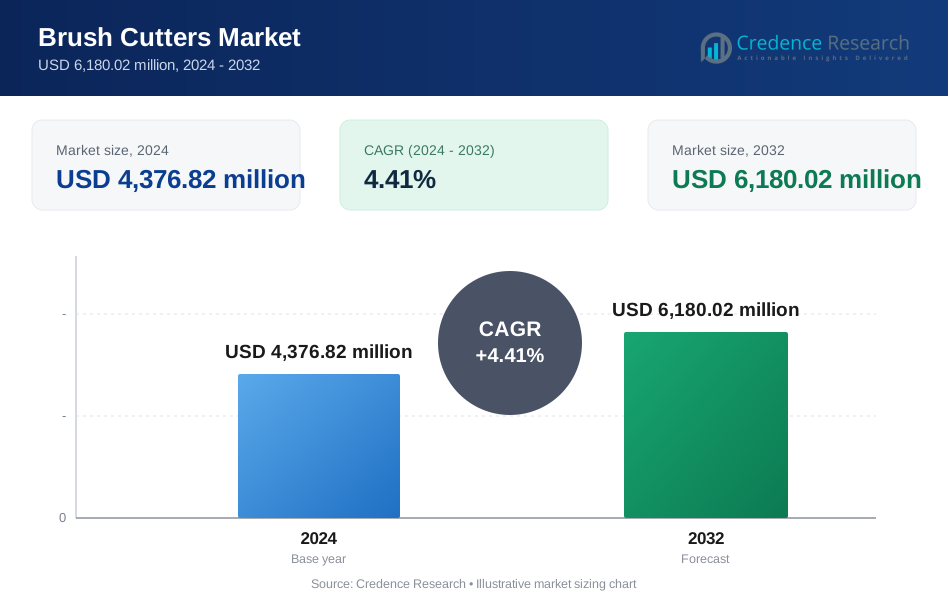
The Global Brush Cutters Market is projected to grow from USD 4,376.82 million in 2024 to an estimated USD 6,180.02 million by 2032, with a compound annual growth rate (CAGR) of 4.41% from 2024 to 2032.
Several factors are propelling the growth of the brush cutters market. The rise in landscaping and gardening activities, particularly in urban areas, has led to increased demand for efficient vegetation management tools. Technological advancements, such as the development of battery-powered and cordless brush cutters, offer eco-friendly and low-noise alternatives to traditional gas-powered models, aligning with environmental regulations and consumer preferences. Additionally, the integration of lithium-ion batteries has enhanced the performance and convenience of these tools. Manufacturers are also investing in ergonomic designs and lightweight models to improve user comfort and reduce fatigue during prolonged use. Moreover, the growing popularity of do-it-yourself (DIY) gardening trends is further stimulating product adoption among residential users.
Regionally, North America holds a significant share of the brush cutters market, driven by a strong culture of lawn and garden maintenance, as well as the presence of major manufacturers. Europe follows closely, with a focus on sustainable landscaping practices and stringent environmental regulations promoting the adoption of electric brush cutters. The Asia-Pacific region is expected to witness substantial growth due to rapid urbanization, increasing disposable incomes, and a growing interest in gardening and landscaping activities. Countries like China, India, and Japan are experiencing rising demand for mechanized tools in the agricultural and horticultural sectors. Additionally, government initiatives promoting green spaces and public parks across urban centers are expected to further support market growth in the region.
Market Insights:
- The Global Brush Cutters market is projected to grow from USD 4,376.82 million in 2024 to USD 6,180.02 million by 2032, registering a CAGR of 4.41%, driven by rising demand for efficient vegetation tools.
- Increasing urban landscaping and DIY gardening trends are accelerating the adoption of brush cutters, particularly in suburban residential areas.
- Technological advancements, including cordless and battery-powered models with ergonomic features, are reshaping consumer preferences.
- Commercial and agricultural sectors are expanding their use of brush cutters for large-scale maintenance, especially in areas unsuitable for heavy machinery.
- Environmental regulations are steering demand toward low-emission electric models, prompting manufacturers to invest in sustainable innovations.
- Market penetration remains limited in underdeveloped regions due to affordability issues, low awareness, and lack of distribution infrastructure.
- Regionally, North America holds a major share, followed by Europe and Asia-Pacific, with the latter poised for fastest growth due to urbanization and supportive government initiatives.
Report Scope
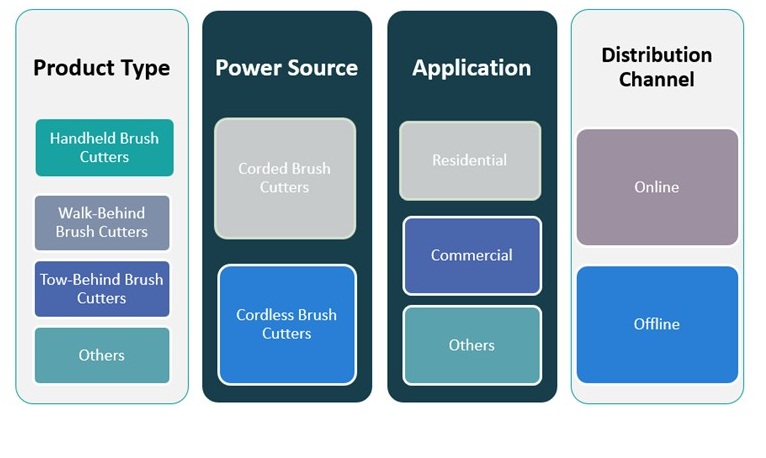
This report segments the Brush Cutters Market as follows:
Market Drivers:
Rising Demand from Landscaping and Gardening Activities
The growing interest in landscaping and home gardening has become a major driver for the global brush cutters market. For instance, companies such as Husqvarna and STIHL have reported increased demand for brush cutters, particularly in suburban and residential markets, where consumers seek efficient tools for maintaining garden aesthetics and property value. As urban populations expand and more people invest in maintaining residential gardens and outdoor spaces, the need for efficient and versatile vegetation management tools is rising. Brush cutters, known for their ability to clear thick grass, shrubs, and small trees, are increasingly preferred over traditional trimmers for their power and functionality. This trend is particularly prominent in suburban areas where garden aesthetics and property maintenance play a crucial role in residential value.
Technological Advancements in Equipment Design
Technological innovations are significantly shaping the brush cutters market by enhancing product features and performance. For instance, STIHL’s latest models feature advanced fuel efficiency and low-noise technology, targeting urban consumers and professionals who require quieter operations. The introduction of battery-powered and cordless brush cutters has addressed critical concerns around noise, emissions, and ease of use. These models cater to environmentally conscious consumers and align with regulations aimed at reducing the carbon footprint of garden equipment. Improvements in lithium-ion battery technology have extended the operational time of these tools, making them more viable for both domestic and commercial use. Additionally, manufacturers are investing in ergonomic designs to enhance user comfort, reduce operator fatigue, and improve handling during prolonged usage.
Expansion of Commercial and Agricultural Applications
Beyond residential use, the demand for brush cutters is rising in commercial landscaping and agriculture. Municipalities, construction firms, and landscape service providers rely on brush cutters for large-scale vegetation management, roadside maintenance, and clearing operations. In agriculture, brush cutters are employed to manage undergrowth around crops, orchards, and plantations, improving accessibility and crop health. Their ability to function in rugged terrains and tackle dense vegetation makes them a valuable tool in settings where tractors and larger machinery may not be feasible. This diversification of use cases is contributing to the consistent market expansion across different sectors.
Supportive Regulatory and Environmental Trends
Environmental concerns and regulatory pressures are also influencing purchasing decisions in the brush cutters market. Government bodies in North America and Europe are increasingly enforcing emission norms and noise restrictions for outdoor power equipment. As a result, demand is shifting toward electric and hybrid models that offer sustainable operation without compromising performance. Simultaneously, consumer awareness regarding eco-friendly practices is encouraging the adoption of low-emission equipment. Incentives for using energy-efficient tools and subsidies for sustainable landscaping practices are further supporting the market shift toward innovative and environmentally compliant brush cutter models.
Market Trends:
Integration of Smart Technologies in Brush Cutters
One of the prominent trends in the global brush cutters market is the integration of smart technologies aimed at enhancing user experience and equipment efficiency. For example, several robotic brush cutter models now offer mobile phone connectivity, allowing users to control the device remotely and set virtual boundaries for operation. Manufacturers are incorporating features such as digital displays, automated throttle control, and vibration-reduction systems to improve operational precision and comfort. Some high-end models now feature Bluetooth connectivity and mobile app integration, enabling real-time monitoring of battery levels, maintenance schedules, and performance diagnostics. These advancements are attracting tech-savvy consumers and professional users who prioritize convenience, precision, and maintenance efficiency, thereby shifting the market toward more sophisticated, feature-rich equipment.
Shift Toward Lightweight and Multi-functional Models
As consumer expectations evolve, there is an increasing preference for lightweight, multi-functional brush cutter models that offer ease of handling without compromising power. ECHO’s Pro Attachment Series, for instance, allows users to operate up to 16 different attachments-including trimmers, hedge trimmers, and blowers-using a single powerhead, maximizing utility while saving on storage space and cost. Manufacturers are developing tools that combine brush cutting with functions such as grass trimming, hedge cutting, and edging by offering interchangeable attachments. This shift reflects a broader trend toward tool versatility and space-saving solutions, particularly among urban consumers with limited storage areas. In response to this trend, product designs are becoming more compact and ergonomic, allowing users across both residential and commercial sectors to maximize utility with a single device.
Growing Adoption of Battery-powered Equipment
While the transition to battery-powered tools has been a response to environmental regulations, it is now emerging as a significant trend in its own right. Battery-powered brush cutters are gaining popularity not only due to lower emissions and quieter operations but also because of advancements in battery technology that have led to longer runtimes and faster charging cycles. These developments make battery-powered models more competitive with their gasoline counterparts, especially for medium-duty applications. Additionally, the total cost of ownership is becoming more favorable as users benefit from lower fuel and maintenance costs, prompting a wider shift across residential, municipal, and commercial end-users.
Expansion of E-commerce and Online Product Customization
The rise of e-commerce is transforming how consumers access and purchase brush cutters, with major players offering detailed product comparisons, virtual demonstrations, and customization options online. Digital platforms are empowering buyers with more control over product specifications, including power source, shaft type, blade style, and warranty plans. Furthermore, online reviews and video tutorials are influencing buyer behavior, especially among first-time and DIY users. This growing digital footprint not only increases brand visibility but also provides manufacturers with critical data on consumer preferences, enabling them to refine offerings and launch targeted marketing campaigns across regional markets.
Market Challenges Analysis:
High Initial Costs and Maintenance Burden
One of the key restraints in the global brush cutters market is the high upfront cost of advanced models, particularly those equipped with battery power, smart features, or multi-functionality. For instance, Bholanath’s battery-operated brush cutters are priced between ₹59,100 and ₹99,499 (approximately $700–$1,200 USD), reflecting the high upfront investment required for advanced models with features like lithium-ion batteries and multi-functionality. While these models offer long-term efficiency, their initial investment can deter budget-conscious consumers, especially in emerging markets. Moreover, brush cutters—whether gas-powered or electric—require regular maintenance, including blade sharpening, motor servicing, and battery replacements. These ongoing expenses and operational complexities often discourage casual users and small-scale buyers who may opt for more affordable or manual alternatives.
Stringent Emission and Noise Regulations
Another significant challenge arises from increasingly stringent environmental regulations, especially in regions such as Europe and North America. While these regulations are pushing the market toward more sustainable solutions, compliance often involves additional manufacturing costs and R&D investments for product development. Small and mid-sized manufacturers may find it difficult to compete with established brands that can absorb these costs more easily. Additionally, meeting regional regulatory standards often requires localized product variants, which can further complicate production and distribution strategies for global players.
Limited Adoption in Underdeveloped Regions
]The adoption of brush cutters remains limited in underdeveloped and rural regions due to a lack of awareness, affordability constraints, and limited access to modern landscaping equipment. In many parts of Asia, Africa, and Latin America, traditional manual tools are still prevalent due to their low cost and availability. The absence of proper distribution networks and after-sales services in these areas hampers the penetration of brush cutter products. These regional disparities pose a challenge for manufacturers aiming to expand their global footprint and tap into new growth markets.
Market Opportunities:
The global brush cutters market presents significant growth opportunities driven by the rising emphasis on sustainable landscaping and increasing adoption of battery-powered tools. As governments and regulatory bodies across the world implement stricter environmental norms, there is growing demand for low-emission, energy-efficient equipment. This shift is creating space for innovation and the development of electric and hybrid brush cutter models, which cater to eco-conscious consumers and commercial users seeking regulatory compliance. Additionally, the global trend toward urban greening—supported by public and private initiatives to enhance green infrastructure—continues to stimulate demand for modern vegetation management tools. This scenario offers manufacturers the opportunity to introduce cleaner, quieter, and more technologically advanced brush cutter models to new customer segments.
Emerging economies also offer untapped potential for market expansion. Countries in Southeast Asia, Latin America, and parts of Africa are witnessing rapid urbanization, increasing disposable income, and growing awareness of modern landscaping and agricultural tools. These regions are gradually moving away from manual methods toward mechanized solutions to improve productivity and efficiency. The expansion of e-commerce and digital retail platforms further facilitates market entry by allowing manufacturers to reach underserved regions with minimal overhead. Customization, localization of product features, and strategic partnerships with local distributors can help brands penetrate these markets effectively. As awareness grows and access improves, the adoption of brush cutters in these regions is expected to rise, presenting a long-term opportunity for both established players and new entrants in the global brush cutters market.
Market Segmentation Analysis:
The global brush cutters market is segmented by product type, power source, application, and distribution channel, each contributing uniquely to overall market dynamics.
By product type, handheld brush cutters dominate the market due to their lightweight design, affordability, and versatility in residential and small-scale commercial landscaping tasks. Walk-behind brush cutters are preferred for heavy-duty applications such as clearing overgrown grass, while tow-behind variants serve agricultural and large-field maintenance operations, offering high power and efficiency. The others category includes niche products designed for specific terrain or use cases.
By power source, the market is witnessing a strong shift toward cordless brush cutters, fueled by advancements in lithium-ion battery technology and rising environmental concerns. Corded brush cutters, while cost-effective, are limited in mobility, making them suitable for small gardens and confined spaces.
By application, the residential segment holds the largest share, driven by the DIY gardening trend and rising household landscaping. The commercial segment includes municipalities and landscaping firms using high-capacity equipment for large-scale projects. Other applications include agriculture and forestry.
By distribution channel, offline sales remain dominant due to the need for product demonstrations and immediate servicing. However, online platforms are rapidly gaining traction, offering wider accessibility, user reviews, and product variety, particularly in urban and emerging markets.
Segmentation:
By Product Type
- Handheld Brush Cutters
- Walk-Behind Brush Cutters
- Tow-Behind Brush Cutters
- Others
By Power Source
- Corded Brush Cutters
- Cordless Brush Cutters
By Application
- Residential
- Commercial
- Others
By Distribution Channel
- Online
- Offline
Regional Analysis:
The global brush cutters market demonstrates varied growth patterns across key regions, each influenced by local economic conditions, consumer preferences, and regulatory frameworks. North America leads the global market, accounting for 31.2% of the total market share in 2024. The region benefits from a strong culture of home gardening, widespread adoption of landscaping services, and a high concentration of professional landscaping companies. Moreover, consumer inclination toward cordless and eco-friendly brush cutters, supported by favorable government regulations on emissions and noise, continues to drive market growth in the United States and Canada.
Europe follows closely, holding 28.5% of the global market share. The region has seen rising demand for sustainable landscaping tools, with electric and battery-powered brush cutters gaining popularity due to strict environmental regulations. Countries such as Germany, France, and the United Kingdom are adopting low-emission gardening equipment as part of their broader climate action goals. Additionally, the prevalence of urban green spaces and public gardening initiatives across Europe supports steady product demand in both residential and municipal sectors.
Asia-Pacific is emerging as the fastest-growing region, projected to expand significantly in the coming years while currently capturing 22.7% of the global market share. This growth is primarily driven by increasing urbanization, rising disposable income, and an expanding middle class with growing interest in modern gardening tools. Countries like China, India, and Japan are seeing robust demand, particularly in agriculture and semi-urban landscaping applications. Government support for mechanized agriculture and the increasing popularity of DIY gardening are further accelerating regional market penetration.
Latin America represents 10.4% of the global market, with countries such as Brazil, Mexico, and Argentina contributing to the demand for both residential and agricultural brush cutter applications. The region is gradually adopting battery-powered models, though affordability and access remain key barriers. Meanwhile, the Middle East & Africa (MEA) region holds the remaining 7.2% share, where growth is moderate but improving due to expanding urban infrastructure and interest in landscaping around commercial and public buildings. The limited availability of distribution networks and after-sales services continues to constrain faster adoption in several MEA countries, though opportunities exist for market entrants focusing on localized strategies.
Key Player Analysis:
- STIHL
- DeWALT
- Echo
- MTD Products
- Stanley Black & Decker
Competitive Analysis:
The global brush cutters market is moderately fragmented, with several international and regional players competing on product innovation, pricing, and distribution strength. Leading companies such as Husqvarna Group, STIHL Group, Echo Incorporated, and Honda Motor Co., Ltd. dominate the market by offering a wide range of gasoline and battery-powered models catering to both residential and professional users. These players invest heavily in research and development to enhance product performance, ergonomics, and energy efficiency. Emerging brands are leveraging e-commerce platforms and localized marketing to gain traction in price-sensitive markets. Strategic partnerships, mergers, and geographic expansions are becoming common as companies aim to strengthen their global footprint and meet evolving consumer demands. The competitive landscape is further influenced by the rising demand for low-emission and multi-functional brush cutters, prompting manufacturers to prioritize sustainability and user-centric design in their innovation pipelines. Continuous technological advancement remains a critical factor for long-term market leadership.
Recent Developments:
- In early 2025, STIHL rolled out a comprehensive lineup of new battery-powered outdoor tools, focusing on innovations in trimmers, blowers, mowers, and heavy-duty equipment. The 2025 catalog highlights models such as the HSA 140 T/R hedge trimmers, the KGA 770 battery-powered sweeper, and the TSA 300 battery-powered concrete saw, emphasizing improved performance and environmental friendliness. STIHL’s strategy this year is clearly geared toward expanding its battery-powered offerings, with more than 50 new products introduced to the market.
- In March 2025, DeWALT, a brand under Stanley Black & Decker, expanded its outdoor power equipment lineup by launching new gas and battery-powered products. Notable releases include the 60V MAX* Brushless Cordless Backpack Blower, new walk-behind mowers, and a range of handheld tools such as pole saws, chainsaws, and hedge trimmers. These products are designed to enhance productivity and cater to both residential and professional landscaping needs.
Market Concentration & Characteristics:
The global brush cutters market exhibits a moderately fragmented structure, characterized by the presence of several international and regional players. Leading companies such as Husqvarna Group, STIHL Group, Echo Incorporated, and Honda Motor Co., Ltd. dominate the market by offering a wide range of gasoline and battery-powered models catering to both residential and professional users. These key players collectively hold a significant portion of the market share, leveraging their extensive distribution networks, strong brand recognition, and continuous investment in research and development to maintain their competitive edge. The market is marked by a diverse product portfolio that includes corded, cordless, and engine-driven brush cutters, addressing various consumer needs across residential, commercial, and agricultural sectors. Technological advancements, particularly in battery technology and ergonomic design, have led to the introduction of more efficient and user-friendly models. Additionally, the increasing emphasis on environmentally friendly and low-noise equipment has spurred the development of electric and hybrid brush cutters. Despite the dominance of established brands, the market remains open to new entrants, especially those focusing on innovation and sustainability, indicating a dynamic and evolving competitive landscape.
Report Coverage:
The research report offers an in-depth analysis based on Product Type, Power Source, Application and Distribution Channel. It details leading market players, providing an overview of their business, product offerings, investments, revenue streams, and key applications. Additionally, the report includes insights into the competitive environment, SWOT analysis, current market trends, as well as the primary drivers and constraints. Furthermore, it discusses various factors that have driven market expansion in recent years. The report also explores market dynamics, regulatory scenarios, and technological advancements that are shaping the industry. It assesses the impact of external factors and global economic changes on market growth. Lastly, it provides strategic recommendations for new entrants and established companies to navigate the complexities of the market.
Future Outlook:
- The global brush cutters market is projected to witness steady growth through 2032, driven by rising demand for efficient vegetation management tools.
- Increasing urbanization and the expansion of residential landscaping activities will continue to boost market penetration.
- Battery-powered brush cutters will gain significant traction due to advancements in lithium-ion technology and environmental regulations.
- Product innovation focused on lightweight design and multi-functionality will cater to evolving consumer preferences.
- E-commerce growth will enhance product accessibility, especially in emerging markets with limited physical retail infrastructure.
- North America and Europe will remain key revenue contributors, supported by professional landscaping demand and regulatory compliance.
- Asia-Pacific will emerge as the fastest-growing region due to expanding agricultural mechanization and urban development.
- Technological integration, such as smart monitoring features, will differentiate premium product offerings.
- OEMs and new entrants will invest in sustainable manufacturing and energy-efficient designs to align with green mandates.
- Strategic partnerships and localized marketing will shape long-term global expansion and competitive positioning.
Request a Free Sample
Fill in your details and we'll send you a free sample report.
- Sample data tables & charts
- Research methodology
Need a Custom Version of This Report?
Tailor the scope, geography, or segments to your exact requirements.
- Custom geography or segment scope
- Direct access to our analyst team
Frequently Asked Questions
What is the current size of the Global Brush Cutters Market?
What factors are driving the growth of the Global Brush Cutters Market?
What are some challenges faced by the Global Brush Cutters Market?
Who are the major players in this Market?
Table of Content
Chapter 1. Report Introduction
- 1.1 Report Description & Purpose
- 1.1.1 Report Title & Market Definition
- 1.1.2 Unique Selling Propositions (USP) & Key Differentiators
- 1.1.3 Value Proposition for Stakeholders
- 1.2 Research Objectives
- 1.2.1 Market Sizing Objectives (Volume & Revenue)
- 1.2.2 Segmentation Objectives
- 1.2.3 Competitive Intelligence Objectives
- 1.2.4 Forecast & Scenario Objectives
- 1.3 Report Scope
- 1.3.1 Brush Cutters Scope – Types & Subtypes Covered
- 1.3.2 Geographic Scope – Regions & Countries Covered
- 1.3.3 Historical Period, Base Year & Forecast Period (2024; forecast to 2032)
- 1.3.4 Inclusions & Exclusions
- 1.4 HS Code & Classification Framework
- 1.5 Currency, Units & Pricing Basis
- 1.6 Target Stakeholders
- 1.7 Limitations & Assumptions
Chapter 2. Executive Summary
- 2.1 Global Brush Cutters Market Snapshot
- 2.1.1 Market Size – Historical (2024) & Forecast (2024-2032) (2024: USD 4,376.82 million → 2032: USD 6,180.02 million)
- 2.1.2 Volume & Revenue – Global Totals
- 2.1.3 Key Market Highlights – Top Five Facts
- 2.2 Brush Cutters Market Segmentation Snapshot
- 2.2.1 Market Split by Region – 2024 vs. 2032
- 2.3 Competitive Snapshot
- 2.3.1 Top 10 Players by Revenue Share – 2024
- 2.3.2 Top 10 Players by Volume Share – 2024
- 2.3.3 Recent Strategic Developments (18-Month Summary)
- 2.4 Key Investment Highlights & Strategic Conclusions
Chapter 3. Brush Cutters Market Dynamics & Industry Analysis
- 3.1 Market Overview & Context
- 3.1.1 Brush Cutters Market Position in the Broader Automotive Value Chain
- 3.1.2 OEM vs. Replacement Market Dynamics
- 3.1.3 Market Maturity & Development Stage by Region
- 3.2 Brush Cutters Market Drivers
- 3.3 Brush Cutters Market Restraints & Challenges
- 3.4 Brush Cutters Market Opportunities
- 3.5 Porter's Five Forces Analysis
- 3.5.1 Threat of New Entrants
- 3.5.2 Bargaining Power of Suppliers
- 3.5.3 Bargaining Power of Buyers
- 3.5.4 Threat of Substitutes
- 3.5.5 Competitive Rivalry – Intensity Assessment
- 3.6 Brush Cutters Value Chain Analysis
- 3.6.1 Upstream – Raw Material/Input Suppliers
- 3.6.1.1 Raw Material/Input 1
- 3.6.1.2 Raw Material/Input 2
- 3.6.1.3 Raw Material/Input 3
- 3.6.2 Midstream – Production/Manufacturing/Service Delivery
- 3.6.2.1 Production/Process Overview
- 3.6.2.2 Key Facility Locations & Capacity by Manufacturer
- 3.6.3 Downstream – Distribution & End Consumer
- 3.6.3.1 Primary Channel – B2B/OEM
- 3.6.3.2 Secondary Channels – Dealer, Retail, Online, Direct
- 3.6.4 Value Chain Profitability Analysis
- 3.6.1 Upstream – Raw Material/Input Suppliers
- 3.7 PESTEL Analysis
- 3.7.1 Political Factors
- 3.7.2 Economic Factors
- 3.7.3 Social Factors
- 3.7.4 Technological Factors
- 3.7.5 Environmental Factors
- 3.7.6 Legal Factors
- 3.8 Brush Cutters Supply Chain Analysis
- 3.8.1 Raw Material/Input Supply Risk Assessment
- 3.8.2 Manufacturing Concentration Risk (Geographic Exposure)
- 3.8.3 Trade Disruption Impact Analysis
- 3.9 Regulatory & Policy Landscape
Note: The regulatory and policy landscape section covers regulations based on their applicability to the market, Brush Cutters category, geography, and scope of the study. Only regulatory frameworks with a material impact on operations, compliance, trade, sustainability, or market access are analyzed in detail.
Chapter 4. Key Investment Pockets & Opportunity Analysis
- 4.1 Brush Cutters Market Attractiveness Analysis
- 4.1.1 By Region – Investment Attractiveness Matrix (Volume × CAGR)
- 4.2 Absolute Revenue Growth Opportunity
- 4.2.1 By Region – Absolute USD Growth Through 2032
- 4.3 Incremental Volume Opportunity
- 4.3.1 By Region – Incremental Volume Through 2032
- 4.3.2 Segment – Incremental Volume
- 4.4 Emerging Submarket Opportunity Deep Dive (Subject to Applicability)
- 4.5 Emerging Market Opportunity Scorecards
- 4.5.1 United States
- 4.5.2 Europe
- 4.5.3 Asia
- 4.5.4 Middle East & Africa
Note: Emerging Market Opportunity Scorecards will be included based on relevance and strategic importance. Regions listed are indicative and may vary depending on data availability and market dynamics.
Chapter 5. Brush Cutters Import-Export Analysis & Trade Flows
- 5.1 Global Trade Overview
- 5.1.1 Global Export Value by Country (2024)
- 5.1.2 Global Export Volume by Country (2024)
- 5.1.3 Global Import Value by Country (2024)
- 5.1.4 Global Import Volume by Country (2024)
- 5.1.5 Net Trade Balance by Country (2024)
- 5.2 Export Analysis – Segment
- 5.2.1 Type 1 (HS Code)
- 5.2.2 Type 2 (HS Code)
- 5.2.3 Type 3 (HS Code)
- 5.2.4 Type 4 (HS Code)
- 5.2.5 Type 5 (HS Code)
- 5.3 Import Analysis – Segment
- 5.3.1 Type 1 (HS Code)
- 5.3.2 Type 2 (HS Code)
- 5.3.3 Type 3 (HS Code)
- 5.3.4 Type 4 (HS Code)
- 5.3.5 Type 5 (HS Code)
- 5.4 Average Unit Trade Prices
- 5.4.1 Average Export Price – Segment & Country
- 5.4.2 Average Import Price – Segment & Source Country
- 5.4.3 Price Trends (2024)
- 5.5 Key Trade Route Analysis
- 5.5.1 Trade Route 1
- 5.5.2 Trade Route 2
- 5.5.3 Trade Route 3
- 5.5.4 Trade Route 4
- 5.5.5 Trade Route 5
- 5.6 Trade Policy Impact Assessment
- 5.6.1 US Anti-Dumping & Section 301 Tariffs
- 5.6.2 EU Customs Union Impact
- 5.6.3 Major Free Trade Agreements
- 5.6.4 USMCA Rules of Origin
Note: Trade policy analysis will be included only where relevant to the Brush Cutters market.
Chapter 6. Competitive Landscape & Company Benchmarking
- 6.1 Brush Cutters Market Concentration & Structure
- 6.1.1 Herfindahl-Hirschman Index (HHI) – vs. 2024
- 6.1.2 Tier 1, Tier 2 & Tier 3 Market Structure
- 6.1.3 Global, Regional & Local Player Dynamics
- 6.2 Brush Cutters Market Share Analysis – 2024
- 6.2.1 Global Revenue Share by Company
- 6.2.2 Global Volume Share by Company
- 6.2.3 Regional Revenue Share
- 6.2.4 Market Share Evolution ( vs. 2024)
- 6.2.5 OEM Segment Share by Company
- 6.2.6 Replacement Segment Share by Company
- 6.3 Production/Delivery Capacity & Facility Analysis
- 6.3.1 Global Installed Capacity
- 6.3.2 Capacity Utilization Rates
- 6.3.3 Production/Output Volume
- 6.3.4 Facility Locations & Capacity Map
- 6.3.5 Planned Capacity Additions
- 6.4 Brush Cutters Competitive Benchmarking Matrix
- 6.4.1 Revenue, Volume, CAGR & Profitability Comparison
- 6.4.2 Channel Revenue Mix
- 6.4.3 Geographic Revenue Exposure
- 6.4.4 R&D Intensity
- 6.4.5 Sustainability Maturity
- 6.5 Strategic Developments in Brush Cutters (Last 24 Months)
- 6.5.1 Mergers, Acquisitions & Divestments
- 6.5.2 New Brush Cutters Launches
- 6.5.3 Facility Expansions
- 6.5.4 Strategic Alliances, Joint Ventures & Partnerships
- 6.5.5 Distribution Expansion & Market Entry
- 6.5.6 Sustainability & ESG Initiatives
- 6.6 Competitive Strategy Mapping
- 6.6.1 Leader, Challenger, Follower & Niche Classification
- 6.6.2 Pricing Strategy Comparison
- 6.6.3 Channel Strategy Matrix
Note: Strategic developments are included based on their materiality and the availability of reliable information.
Chapter 7. Global Brush Cutters Market – By Distribution Channel
- 7.1 Segment Overview
- 7.1.1 Volume & Revenue Split by Channel (2024 & 2032)
- 7.1.2 Channel Mix Evolution (2024-2032)
Chapter 8. Regional Market Analysis – Global Overview
- 8.1 Global Regional Overview
- 8.1.1 Regional Volume Share
- 8.1.2 Regional Revenue Share
- 8.1.3 Regional Volume by Region
- 8.1.4 Regional Revenue by Region
- 8.1.5 Regional Forecast Through 2032
- 8.2 Cross-Regional Segment Analysis
- 8.2.1 By Distribution Channel
- 8.2.2 By Brand/Price Tier
Chapter 9. North America Brush Cutters Market
- 9.1 United States
- 9.2 Canada
- 9.3 Mexico
Chapter 10. Europe Brush Cutters Market
- 10.1 Germany
- 10.2 France
- 10.3 Italy
- 10.4 United Kingdom
- 10.5 Spain
- 10.6 Poland
- 10.7 Russia
- 10.8 Netherlands
- 10.9 Belgium
- 10.10 Sweden
- 10.11 Denmark
- 10.12 Norway
- 10.13 Rest of Europe
Chapter 11. Asia Pacific Brush Cutters Market
- 11.1 China
- 11.2 India
- 11.3 Japan
- 11.4 South Korea
- 11.5 Thailand
- 11.6 Indonesia
- 11.7 Vietnam
- 11.8 Malaysia
- 11.9 Australia
- 11.10 Rest of Asia Pacific
Chapter 12. Latin America Brush Cutters Market
- 12.1 Brazil
- 12.2 Argentina
- 12.3 Colombia
- 12.4 Chile
- 12.5 Rest of Latin America
Chapter 13. Middle East Brush Cutters Market
- 13.1 Saudi Arabia
- 13.2 United Arab Emirates
- 13.3 Turkey
- 13.4 Israel
- 13.5 Iran
- 13.6 Rest of the Middle East
Chapter 14. Africa Brush Cutters Market
- 14.1 South Africa
- 14.2 Egypt
- 14.3 Nigeria
- 14.4 Morocco
- 14.5 Rest of Africa
Chapter 15. Brush Cutters Company Profiles
- 15.1 [Company 01]
- 15.1.1 Company Overview
- 15.1.2 Key Management Personnel
- 15.1.3 Products & Services Portfolio
- 15.1.4 Financial Performance
- 15.1.5 Key Market Focus & Geographic Presence
- 15.1.6 Recent Developments & Strategic Initiatives
Note: The company profile list is preliminary and may change based on research findings, market developments, data availability, and client requirements.
Chapter 16. Appendices
- Appendix A – List of Abbreviations & Acronyms
- Appendix B – Industry Classification Code Reference – Full Series
- Appendix C – Production & Capacity Data Tables
- Appendix D – End-Use & Demand Base Tables
- Appendix E – Consumption & Replacement Rate Assumptions
- Appendix F – ASP Reference Tables
- Appendix G – Manufacturing & Facility Database
- Appendix H – Import-Export Data Tables
- Appendix I – Regulatory Summary Tables
- Appendix J – Primary Research Participant List (Anonymized)
- Appendix K – Primary Research Questionnaire Framework
- Appendix L – Data Sources & Bibliography
- Appendix M – Market Size Divergence & Source Comparison
Chapter 17. Research Methodology
- 17.1 Research Framework & Philosophy
- 17.2 Secondary Research – Sources, Hierarchy & Data Extraction
- 17.3 Data Modeling – Bottom-Up & Top-Down Market Sizing
- 17.4 Primary Research – Stakeholder Framework, LOI & Sample Sizes
- 17.5 Forecast Methodology – Regression, Scenario & Sensitivity Analysis
- 17.6 Quality Control – Four-Layer Validation Framework
- 17.7 Limitations & Standard Assumptions
- 17.8 Disclaimer
